
Soundproofing and Acoustics for Schools and Universities
















have any questions?
Transform noisy meeting spaces into focused, professional environments with expert conference room soundproofing solutions.
The short answer
Good classroom acoustics means students hear the teacher clearly from every seat. Aim for a reverberation time of about 0.6 seconds for a typical classroom, set per room from its volume, low background noise and walls that stop sound from the next room. Sound Krafted treats classrooms, lecture halls and studios for schools and universities across Pakistan.
Education buildings in Pakistan are often built with hard plaster, terrazzo and glass, close to busy roads, with ceiling fans and split air-conditioners running all day. The result is echo, noise and tired voices. Our team has worked in acoustics since 2021, and much of our recent work is in universities: studios, labs and auditoriums.
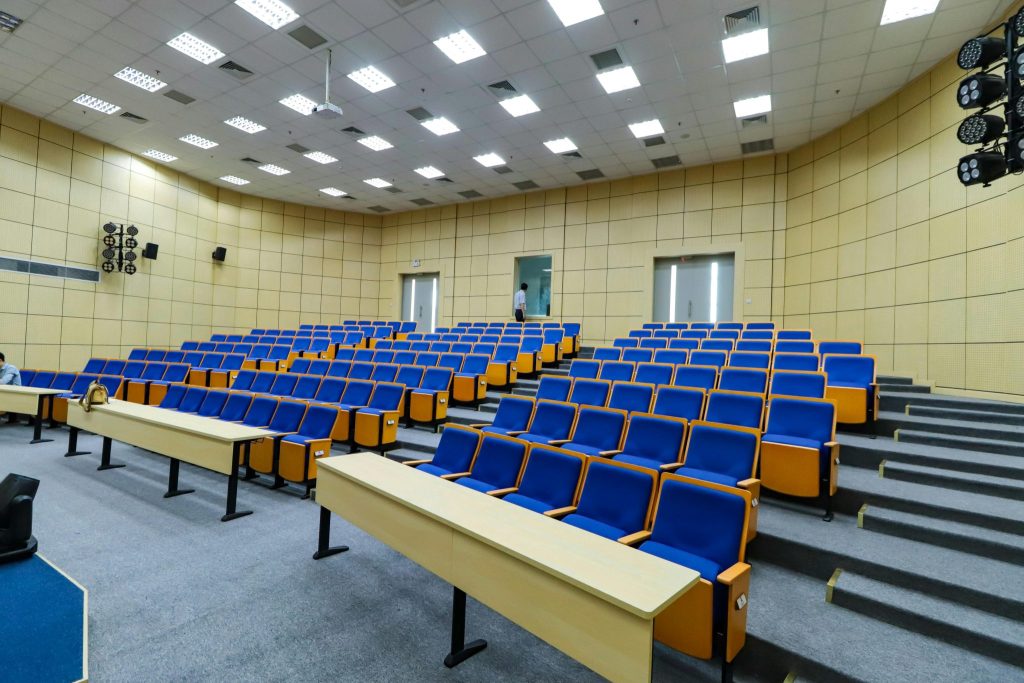
The problems we fix in teaching spaces
| Space | Typical problem | Usual fix |
|---|---|---|
| Classrooms | Echo makes the back rows miss words; corridor noise | Ceiling tiles or panels, rear-wall absorption, door seals |
| Lecture halls | Long reverberation; uneven sound from the PA | Treatment designed with the sound system; speaker layout |
| Libraries and exam halls | Footfall, chairs and voices carry | Absorbent ceilings, soft flooring, quieter services |
| Music rooms and media studios | Sound leaking in and out; poor monitoring | Isolation, room-within-a-room where needed, studio treatment |
| Auditoriums | Unclear speech, echo from the rear wall, noisy AC | Full acoustic design, sound system, seating, lighting |
| Staff rooms and offices next to classrooms | Noise through partitions and doors | Partition upgrades, acoustic doors |
What good classroom acoustics looks like
Two measures matter most. Reverberation time (how long sound lingers, measured to ISO 3382) should be short enough for speech. Background noise from fans, air-conditioning and traffic should be low enough that the teacher does not have to raise their voice. International guidance for teaching spaces, such as ANSI/ASA S12.60 in the United States and BB93 in the United Kingdom, sets targets for both. We use these as references and agree the target for each room with you before design.
Classrooms
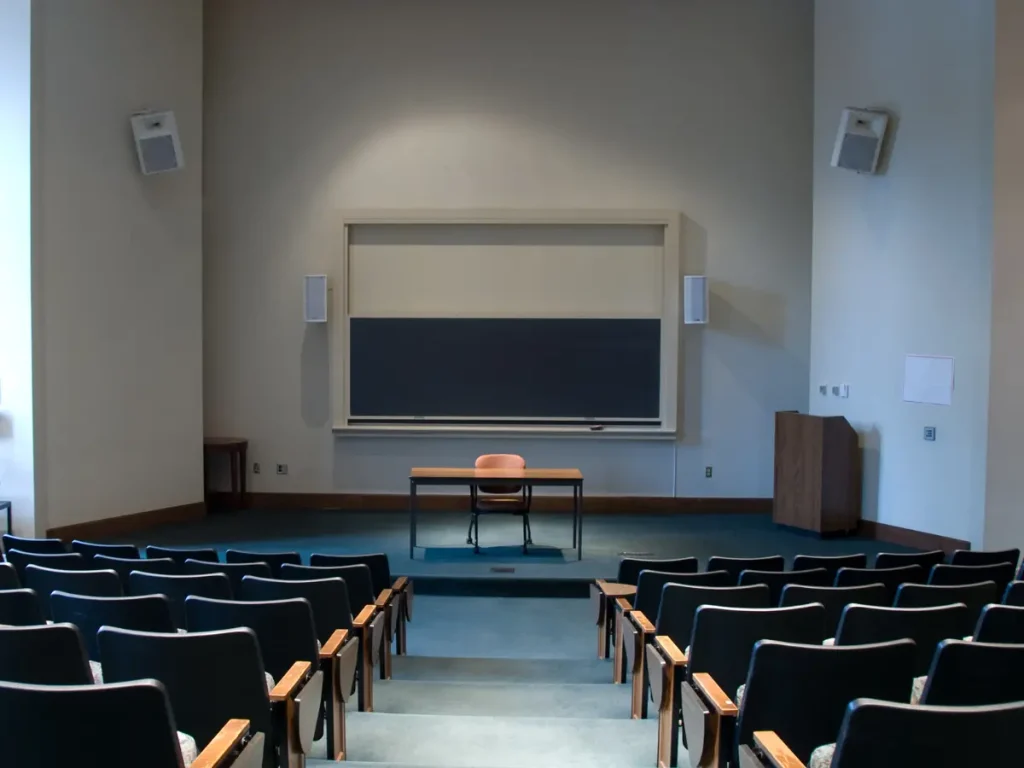
Most classrooms need three things: a sound-absorbing ceiling, some absorption on the rear wall, and doors and windows that keep corridor and road noise out. Ceiling fans and split units should be chosen and placed so they do not drown out the teacher. For young children, language classes and students with hearing difficulties, the targets should be stricter, because they need a clearer signal to follow speech.
| Classroom item | Typical upgrade |
|---|---|
| Ceiling | Acoustic ceiling tiles or panels over most of the area |
| Rear wall | Panels at ear height and above, durable at low level |
| Doors | Solid-core doors with seals, especially next to corridors |
| Windows on busy roads | Laminated or secondary glazing; sealed frames |
| Fans and AC | Quieter units, positioned away from the teacher |
| Between classrooms | Partitions built to the slab; sealed service openings |
Lecture halls and seminar rooms
Lecture halls are long rooms with hard finishes and a raked floor. Without treatment, students at the back miss words and the sound system has to work against the room. We design the acoustic treatment and the speaker layout together, often with column speakers that send sound to the seats and not to the walls. For lecture halls with fixed seating, see lecture-hall seating; for a complete upgrade, see turnkey hall renovation.
Libraries, exam halls and staff areas
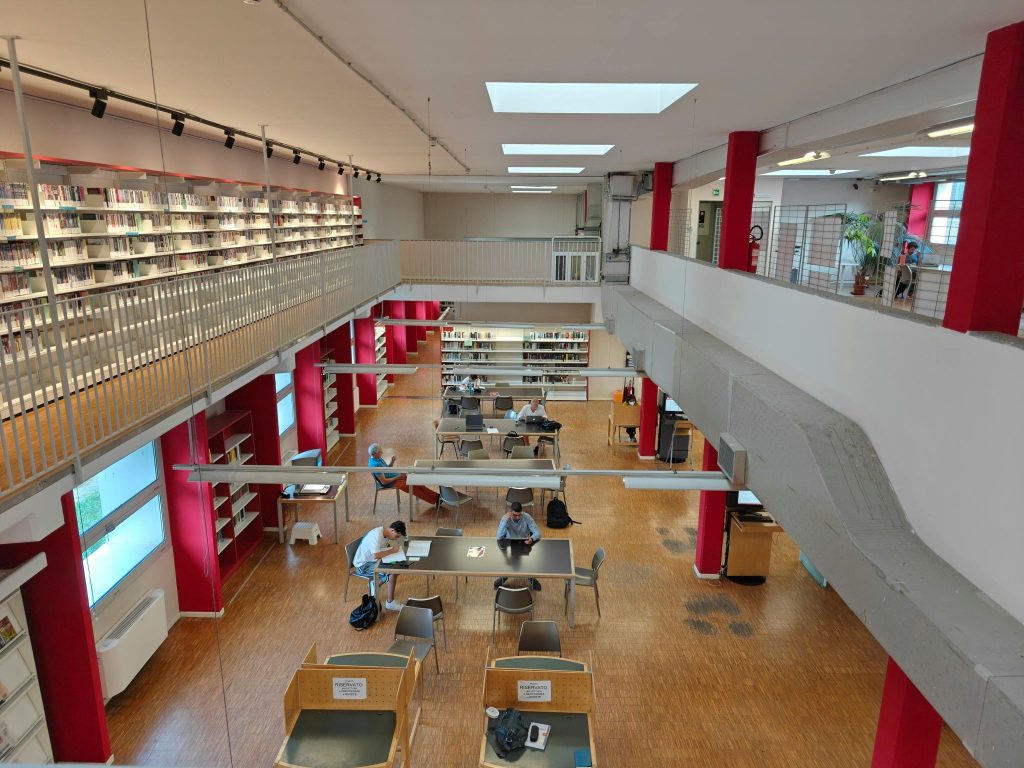
Libraries and exam halls need quiet more than clarity. Absorbent ceilings, soft flooring in circulation areas and quieter services make the biggest difference. Staff rooms and offices beside classrooms need better partitions and doors.
Cost factors for education projects
| Factor | What changes the cost |
|---|---|
| Number of rooms | Repeating the same classroom design keeps unit cost down |
| Ceiling type | Replacing a whole false ceiling versus adding panels below a slab |
| Noise outside | Road-facing windows and doors are often the largest item |
| Halls | Volume, seating, sound system and stage |
| Timing | Holiday work versus night or weekend work in term |
| Procurement | Tender documents, inspections and handover files |
Many universities fund acoustic upgrades through development budgets or HEC-supported projects with their own procurement rules. We prepare BOQs and specifications in the format your procurement office needs; see tender specifications.
Guides in this topic
- Classroom acoustics checklist
- Lecture hall acoustics specification
- Reverberation time and speech clarity in halls
- Campus TV and media studios
- Case studies: UMT studios, BNU lab and music studio
- Auditorium soundproofing, acoustic treatment and doors
- Fire-rated acoustic panels and test reports
Free download
Acoustic room checklist for classrooms and lecture halls. Download the checklist.
How we work with schools and universities
- Free phone consultation to understand the rooms, the timetable and the budget cycle.
- Paid site survey of the rooms, including noise checks and photographs.
- Design, BOQ and specification in a format your procurement office can use. If you are buying through tender, see our tender specifications guide.
- Supply and installation, scheduled around classes, exams and holidays.
- Testing and handover, with documents for your estates team.
Studios, labs and halls on campus
Many universities now run media studios, podcast rooms and AI or post-production labs. These need both acoustic isolation and the right equipment. We build and equip them as one project; see TV and media studio setup for broadcast and media-lab work. For lecture theatres and halls that need seating, stage, lighting and sound together, see turnkey hall renovation and lecture-hall seating.
Education projects on our client list
- Mukabbir University of Science & Technology, Lahore: auditorium acoustic treatment and optimisation, 2025-26.
- Punjab Education Foundation (PEF): turnkey auditorium, 2025-26.
- Business Incubation Center, University of Peshawar: AI podcasting studio (funded by TiE Islamabad), 2025-26.
- COMSATS University Islamabad, Lahore campus: studio infrastructure and equipment, 2024-25.
- University of Narowal: studio infrastructure and equipment, 2024-25.
- University of Sargodha: turnkey MIC studio, 2022-23.
- Pak-Austria Fachhochschule (PAF-IAST), Haripur: labs for video editing, animation, graphics and metaverse development, 2022-23.
- University of Management & Technology (UMT), Lahore: turnkey studio infrastructure, 2021-22.
- Beaconhouse National University (BNU), Lahore: Visual Arts and Design lab and a music studio, 2021-22.
- Iqra University, Virtual University of Pakistan and Quran Academy: regular audio-video and ICT supply.
Plan your campus project
Call or WhatsApp +92 300 8467101 for a free phone consultation. For a design and BOQ, request a site survey.
Sound Krafted · Main Jinnah Park, Harbanspura, Lahore 54850 · Mon to Sat, 9 AM to 5 PM · info@soundkrafted.com
FAQ's
Frequently Asked Questions
Find answers to common questions about our soundproofing and acoustic solutions.
Add absorption where sound reflects most: the ceiling first, then the rear wall. Acoustic ceiling tiles or panels and a band of wall panels at the back usually make a clear difference. A survey sets the amount, so you do not over-treat or under-treat the room.
Usually, yes. Windows and doors are the weak points, so we look at laminated or secondary glazing, sealed doors and quieter ventilation. Walls rarely need rebuilding. Noise measurements arranged during the survey show which openings matter most.
We plan around your timetable. Noisy work is usually done in holidays, at weekends or after classes, and rooms are handed back clean.
Yes. We prepare designs, BOQs and specifications in formats that public and private universities use, with performance targets and test standards named. See our acoustic consultancy service.
Yes. We have built studios for UMT, BNU, COMSATS (Lahore), the University of Sargodha, the University of Narowal and the University of Peshawar's Business Incubation Center, covering both the room and the equipment.
We are based in Lahore and work across Pakistan. Recent education projects are in Lahore, Sargodha, Narowal, Haripur and Peshawar.
Short enough for clear speech. International guidance for ordinary classrooms, such as ANSI/ASA S12.60 and BB93, sets targets of well under a second for typical room sizes. We set the target per room from its volume and use, and design to it.
Often, yes. Panels can be fixed directly to the slab or hung below it, and wall panels added at the back. Replacing the whole ceiling is only needed if it is damaged or must be replaced anyway.
Yes. We prepare designs, BOQs and specifications for public universities, and our clients include the University of Sargodha, the University of Narowal, COMSATS (Lahore campus) and the University of Peshawar's Business Incubation Center.
Echo and background noise make speech harder to follow, especially for younger pupils and those learning in a second language. Clearer speech helps attention, reduces teacher voice strain and can help with listening tasks.
Choose fabric wrapped or polyester fibre panels with a fire rating suitable for public buildings and an NRC of about 0.7 to 0.95. They should be impact resistant at low level and easy to clean.
Large halls need absorption high on the walls and ceiling to control echo, plus a sound system matched to the room. We survey the hall, estimate the reverberation and propose treatment that survives ball impact and daily use.