The short answer: for fire rated acoustic panels in public buildings, ask for a fire classification report for the exact product: BS EN 13501-1 (B-s1, d0 or better), ASTM E84 (Class A) or BS 476 Parts 6 and 7 (Class 0 or 1). It must match the core, facing, thickness and mounting you are buying, alongside the NRC test.
Strictly, acoustic panels carry a reaction-to-fire classification (how readily they ignite, spread flame and make smoke). A “fire rating” in minutes (fire resistance) belongs to walls, doors and ceilings tested as systems. Buyers search for “fire rated acoustic panels”, but what you need is the reaction-to-fire report.
Auditoriums, classrooms, hospitals, offices and government buildings across Pakistan are adding acoustic panels to improve speech clarity. Fire safety must come first. A panel that looks fine and sounds great can still spread flame or produce dense smoke if its core or fabric is not suitable. This guide explains what to ask for and how to read the paperwork.
Why does fire data matter for acoustic panels?
Acoustic panels cover large areas of wall and ceiling, often in rooms full of people with limited exits. Wall and ceiling linings play a big part in how fast a fire spreads and how much smoke is produced. The Building Code of Pakistan (Fire Safety Provisions 2016) and most project specifications require linings with suitable fire performance in public and assembly buildings. Even where a specification is silent, documented fire data protects the client, the consultant and the contractor.
Which fire tests apply to acoustic panels?
BS EN 13501-1 (European classification)
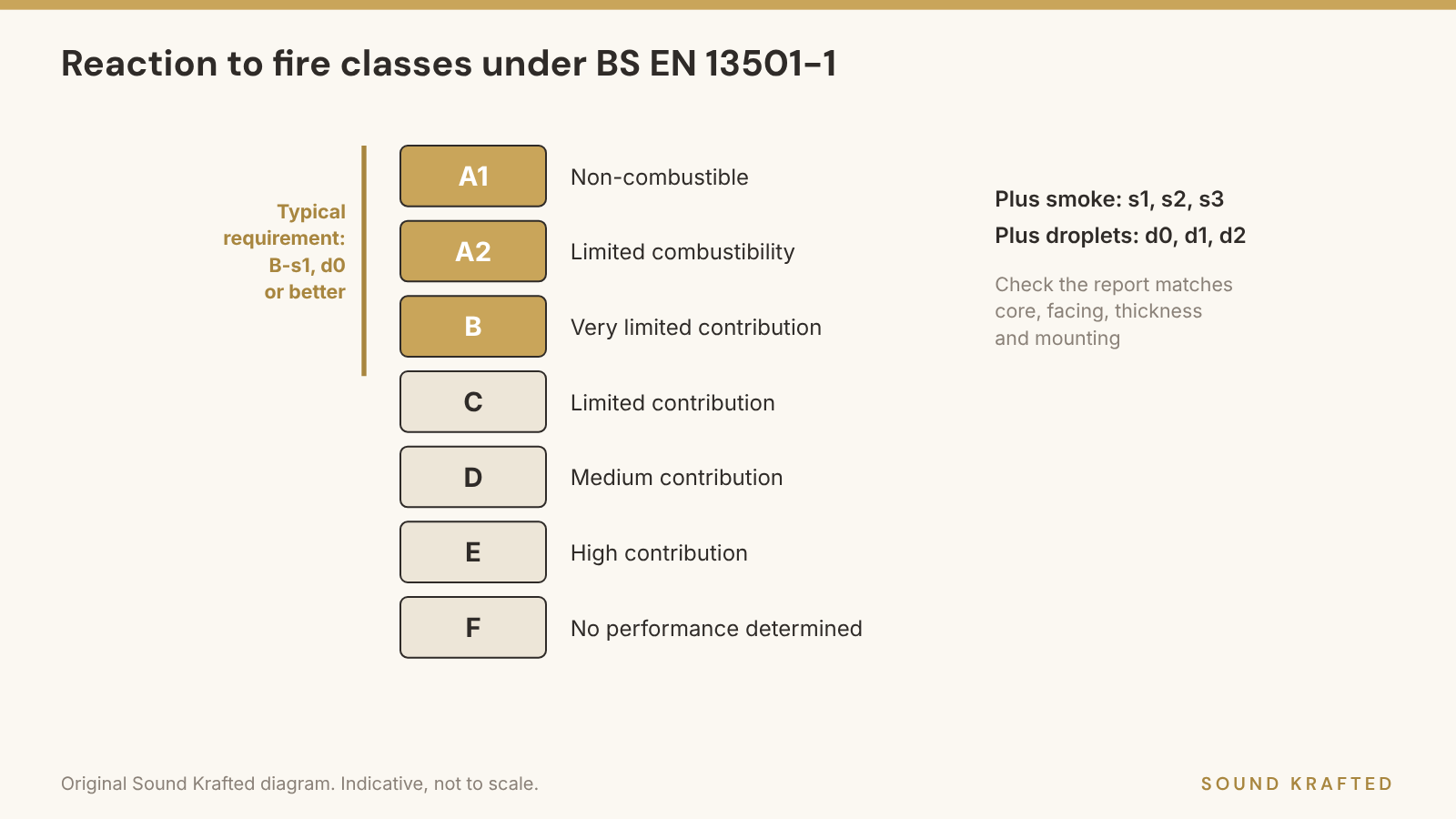
This is the most complete system. It combines several tests to give a reaction to fire class:
| Class | Meaning in simple terms |
|---|---|
| A1 | Non-combustible |
| A2 | Limited combustibility, no significant contribution to fire |
| B | Very limited contribution to fire |
| C | Limited contribution to fire |
| D | Medium contribution to fire |
| E | High contribution to fire |
| F | No performance determined |
It adds two sub-classes: smoke (s1 low, s2 medium, s3 high) and flaming droplets (d0 none, d1 some, d2 many). A typical requirement for linings in public buildings is B-s1, d0 or better. Many mineral wool cores with suitable facings reach A2-s1, d0.
ASTM E84 (American surface burning test)
Also published as UL 723. It measures flame spread and smoke developed along a sample in a tunnel:
| Class | Flame spread index | Smoke developed index |
|---|---|---|
| Class A (or I) | 0 to 25 | 450 or less |
| Class B (or II) | 26 to 75 | 450 or less |
| Class C (or III) | 76 to 200 | 450 or less |
Most specifications ask for Class A for wall and ceiling panels in assembly spaces.
BS 476 Parts 6 and 7 (older British tests)
Still common on data sheets in Pakistan. Part 7 rates surface spread of flame from Class 1 (best) to Class 4. Part 6 measures fire propagation. “Class 0” is a national class that combines a Class 1 result under Part 7 with low Part 6 indices. It is still widely asked for in local specifications, though newer projects increasingly ask for BS EN 13501-1. In the UK, the BS 476 national classes are being phased out in favour of BS EN 13501-1.
For background on how reaction-to-fire tests work in general, see this overview of fire tests.
How do you check a fire test report?
A brochure line saying “fire rated” is not enough. Check these points:
- Product match. The report names the same product, core material, density, thickness and facing (fabric, felt, timber or paint) as the one you are buying.
- Mounting match. Results depend on how the sample was mounted: directly on board, with an air gap, or suspended. The installed method should match.
- Testing body. The test was done by an accredited laboratory, named on the report with its accreditation.
- Classification document. For BS EN 13501-1, there should be a classification report, not only individual test reports.
- Date and validity. Check the date and any expiry or review clause.
- Complete system. Where the fabric and core come from different makers, ask for evidence covering the combination, or for each part plus the system.
What fire report mistakes should you avoid?
- Foam with a “fire retardant” label but no classification report. Many foams have poor fire performance and produce heavy smoke; see acoustic foam vs acoustic panels.
- A good core with an untested fabric. The facing burns first, so it must be included.
- Timber slat panels where the timber was treated but the absorbent backing is untested, or the other way round.
- Reports for a different thickness or density. Results do not automatically transfer.
- Translated or partial reports with missing pages. Ask for the full document.
Do not forget the acoustic data
Fire safety is the first filter, but the panel still has to work. Ask for the sound absorption report alongside the fire report:
- NRC (ASTM C423) or αw (ISO 354, rated to ISO 11654), for the same mounting.
- Typical NRC for 50 mm fabric-wrapped mineral wool panels is about 0.85 to 1.0; thin PET panels mounted directly are much lower. Indicative ranges from published laboratory tests; the BOQ lists tested data for the exact product or system. For insulation cores, see rock wool vs glass wool for soundproofing.
Our explainer on NRC ratings explains how to read absorption data.
Writing it into a specification or tender
For government and institutional projects, put the requirement in the BOQ so every bidder prices the same product. A clear clause might read: “Acoustic wall panels, 50 mm, fabric-wrapped mineral wool core, minimum NRC 0.85 (ASTM C423, Type A mounting), reaction to fire B-s1, d0 or better to BS EN 13501-1 or Class A to ASTM E84. Submit full test and classification reports with the bid.” Our acoustic tender specification guide covers how to write acoustic items for PPRA-compliant tenders.
Keep the reports in the handover file
At handover, the client should receive the fire and acoustic reports for every panel type installed, the product data sheets, and a note of where each type is used. This helps with fire inspections, insurance and future maintenance.
How Sound Krafted handles fire data
We specify panels with the fire data the building needs, list the tested figures in the BOQ, and include the reports in the handover file. See our range of acoustic panels and materials. Our hall work includes the turnkey auditorium for the Punjab Education Foundation and acoustic treatment for the multi-purpose hall of the Women Development Department, Punjab, in Lahore. For halls, see our guide to auditorium soundproofing, acoustic treatment and doors.
Fire data matters for every surface: see acoustic ceilings and sound absorption panels, and our guide to auditorium acoustics for halls.
Frequently asked questions
What fire rating should acoustic panels have?
For public and assembly buildings, a common requirement is B-s1, d0 or better to BS EN 13501-1, or Class A to ASTM E84. Follow the building’s fire plan and specification.
Is mineral wool fire safe?
Mineral wool cores are usually non-combustible or of limited combustibility. The facing and adhesive also matter, so check the classification of the complete panel.
Is Class 0 the same as Class A?
No. Class 0 is a British national class based on BS 476. Class A is an ASTM E84 class. Both indicate good surface performance, but they are different tests.
Can acoustic foam be used in a school or office?
Only if it has a suitable fire classification report for the exact product. Many foams do not, so fabric-wrapped mineral wool or classified PET panels are usually safer choices.
Who should keep the fire reports?
The client, in the project handover file, with copies for the consultant and facility manager.
Get compliant acoustic treatment
Send us your room drawings or tender BOQ and we will recommend panels with the fire and acoustic data your project needs. Request a site survey and BOQ, or call or WhatsApp +92 300 8467101.
About the author: Sound Krafted Acoustics Team. Sound Krafted designs and builds soundproofing and acoustic treatment for government departments, universities, broadcasters and companies across Pakistan. Working since 2021, with 50 projects for 49 organisations. Main Jinnah Park, Harbanspura, Lahore 54850. Mon to Sat, 9 AM to 5 PM. info@soundkrafted.com, +92 300 8467101.