
The short answer: acoustic foam vs acoustic panels comes down to the room. Foam is a light, budget absorber that tames high-frequency echo in small rooms such as vocal booths. Fabric-wrapped mineral wool, PET and timber slat panels absorb a wider range, last longer and are easier to fire-rate, so they suit offices, classrooms and halls. Neither one soundproofs a room.
Many buyers in Lahore, Karachi and Islamabad start with foam because it is easy to find online. Some are happy with it; many end up replacing it. This guide helps you pick the right product the first time.
First, what problem are you solving?
People often say “the room needs soundproofing” when they mean one of two very different things:
| What you hear | What it is | What fixes it |
|---|---|---|
| Echo, boomy speech, poor video calls, a “hollow” sound | Too much reflection inside the room | Absorption: foam or acoustic panels |
| Neighbours, traffic, generators, the next office | Sound passing through walls, doors and windows | Soundproofing: mass, decoupling and seals |
Foam and panels both belong in the first row. If your problem is in the second row, read our guide on soundproofing walls instead. Buying more panels will not stop the shor (noise) from next door.
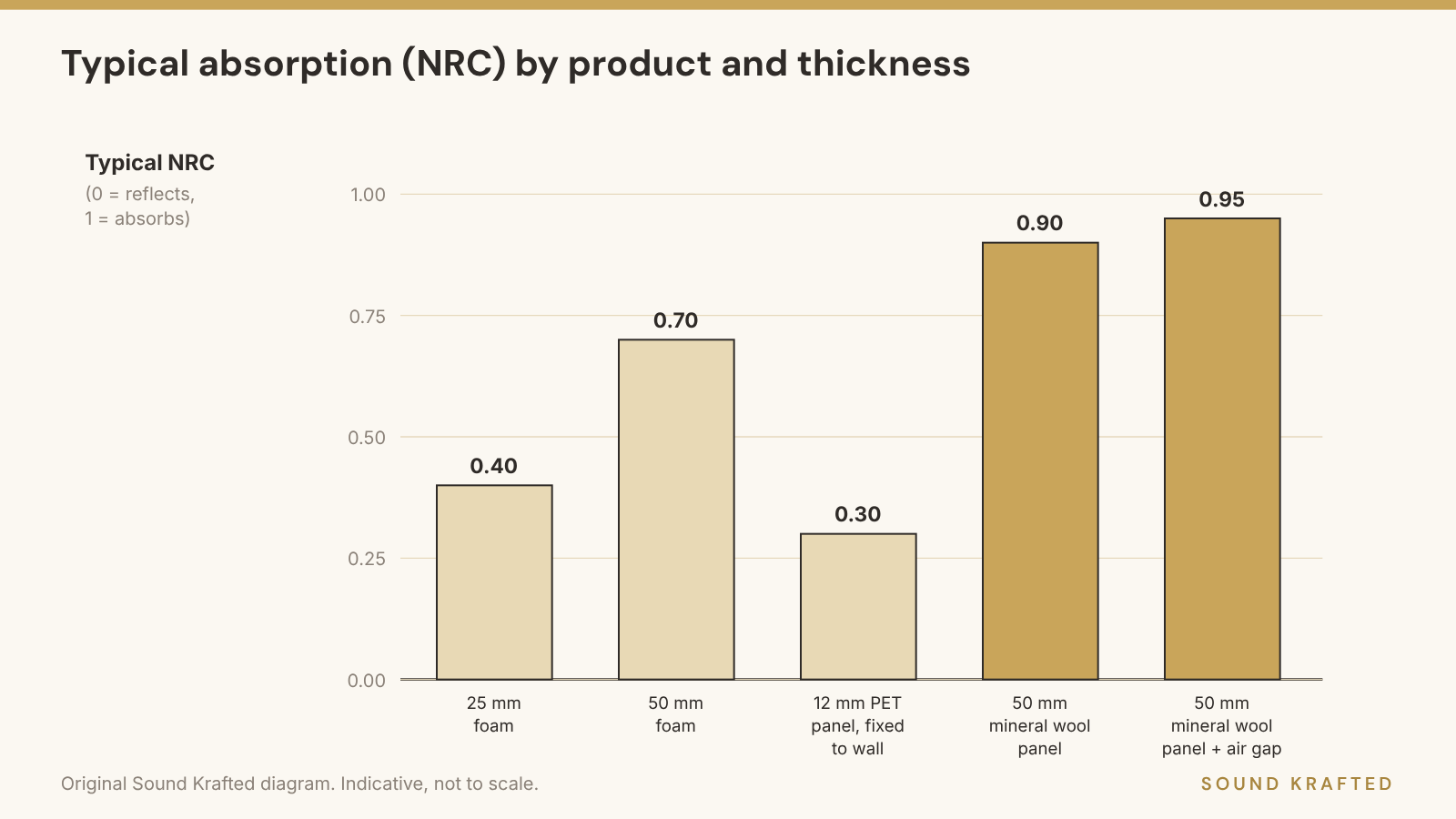
How absorption is measured
Absorbers are rated by NRC (Noise Reduction Coefficient), tested to ASTM C423 or ISO 354, on a scale from 0 to about 1. An NRC of 0.80 means the surface absorbs about 80 per cent of the sound energy that hits it, averaged over the 250, 500, 1000 and 2000 Hz bands. Our acoustic panels and materials page compares the main panel types, and Wikipedia’s NRC article gives a general background on the rating.
NRC is an average, so it hides one important thing: how well a product works at low frequencies. Two products with similar NRC can sound different in a real room.
Side-by-side comparison
| Feature | Acoustic foam | Fabric-wrapped mineral wool | PET (polyester) panel | Timber slat panel |
|---|---|---|---|---|
| Typical NRC | 25 mm: about 0.30 to 0.50; 50 mm: about 0.60 to 0.80 | 50 mm: about 0.85 to 1.0 | 9 to 12 mm on wall: about 0.20 to 0.40; thicker or spaced: higher | Depends on backing: often 0.60 to 0.90 |
| Low-frequency help | Weak unless very thick | Good, better with an air gap | Limited in thin sheets | Good with deep absorbent backing |
| Fire performance | Standard polyurethane foam burns readily and gives off dense, toxic smoke; many “fire retardant” grades still fail public building requirements. Melamine foam can reach B-s1, d0 or ASTM E84 Class A when tested | Good with a classified core and fabric | Varies by product | Depends on timber treatment and backing |
| Durability | Crumbles, fades and collects dust over time | Long life; fabric can be cleaned | Tough, good for touch areas | Long life |
| Look | Studio style, wedges or pyramids | Clean, any colour | Felt look, cut shapes | Warm, architectural |
| Best for | Vocal booths, small home studios | Offices, meeting rooms, halls, classrooms | Schools, corridors, open offices | Boardrooms, lobbies, auditoriums |
Indicative ranges from published laboratory tests; the BOQ lists tested data for the exact product or system.
When is acoustic foam the right choice?
Foam is not a bad product. It is the right tool in a few cases:
- A small vocal booth or podcast corner where you want a dry sound and the budget is tight.
- Temporary treatment in a rented room, where panels would be overkill.
- Spot treatment of first reflections in a small mixing desk position.
In these rooms, use thicker foam (50 mm or more), spread it across several surfaces, and leave some walls untreated so the room does not sound dead and boomy at the same time.
When are acoustic panels the better buy?
In offices, conference rooms, classrooms, masjid halls, auditoriums and government buildings, panels win for four reasons (for halls, see also our guide to auditorium soundproofing, acoustic treatment and doors):
- Broadband absorption. Speech has energy below 500 Hz, where 25 mm foam does little. A 50 mm mineral wool panel, especially with an air gap behind it, absorbs far more at these frequencies.
- Fire safety. Public buildings need materials with tested fire classifications. Classified mineral wool cores and fabrics are easier to document than most foams. Our guide to fire rated acoustic panels and their test reports lists what to ask for.
- Finish and lifespan. Fabric, felt and timber look like part of the interior and last for years. Foam fades and breaks down in sunlight and heat.
- Better value over time. A panel that lasts many years usually costs less over its life than foam that has to be replaced.
Recording studios: often both
Professional studios use a mix: thick panels and bass traps for the low end, diffusers to keep the room lively, and sometimes foam in small spots. The isolation that keeps the studio quiet comes from the walls, floor, ceiling and doors. See our recording studio solutions for how the two jobs fit together. Our studio work includes the music studio for the Punjab Council of the Arts in Lahore and the Visual Arts and Design Lab and music studio for Beaconhouse National University.
How much treatment does a room need?
There is no fixed rule like “cover 30 per cent of the walls”. We calculate the area of absorption needed to reach a target reverberation time (the time it takes sound to die away) for the room’s volume and use. A boardroom used for video calls needs a short reverberation time; a music room needs a balanced one. Then we place panels where they do the most good: the ceiling first in most rooms, then the rear wall, then side-wall reflection points. Our acoustic panel placement guide shows the usual positions.
What shapes the cost
We do not publish prices, because the same panel can be priced very differently once these factors are counted:
- Area to be treated, calculated against a target reverberation time
- Panel type and core: foam, fabric over mineral wool, PET, timber slat, perforated timber
- Thickness and any air gap behind the panel
- Finish: fabric range, veneer, printed graphics, custom shapes
- Fire classification needed for the building
- Installation height, access and working hours
A quick buying checklist
- Is the problem echo inside the room, or noise coming through? Only buy absorbers for echo.
- Ask for the NRC test report for the exact product and thickness.
- For any public or office building, ask for the fire classification report (BS EN 13501-1, ASTM E84 or BS 476).
- Check how the panel is fixed and whether it can be removed for maintenance.
- Treat the ceiling and rear wall before adding more to the front.
Choosing panels for a real room? Our page on sound absorption panels explains NRC, thickness and mounting, and acoustic panels in Lahore covers local supply and fitting.
Frequently asked questions
Is acoustic foam the same as soundproofing?
No. Foam absorbs echo inside the room. It adds almost no mass, so it does not stop sound passing through walls, doors or windows.
Which is better for a home studio, foam or panels?
For a small vocal booth, thick foam can be enough. For a mixing room, fabric-wrapped mineral wool panels and bass traps give a more even sound because they absorb lower frequencies.
Are acoustic panels fire safe?
Many are, but it depends on the core and facing. Ask for a fire classification report for the exact product before using it in an office, school or hall.
How long does acoustic foam last?
It varies by product and conditions. In hot rooms or direct sunlight, foam can fade, harden or crumble within a few years. Fabric and PET panels usually last much longer.
Can panels improve video call quality?
Yes. Echo is a major cause of poor call audio. Treating the ceiling and walls often helps more than buying new microphones.
Get the right treatment first time
Send us the room size, a few photos and what you use the room for. We will recommend the right mix of panels and, where needed, soundproofing. Request a site survey and BOQ, or call or WhatsApp +92 300 8467101.
About the author: Sound Krafted Acoustics Team. Sound Krafted designs and builds soundproofing and acoustic treatment for government departments, universities, broadcasters and companies across Pakistan. Working since 2021, with 50 projects for 49 organisations. Main Jinnah Park, Harbanspura, Lahore 54850. Mon to Sat, 9 AM to 5 PM. info@soundkrafted.com, +92 300 8467101.