
Short answer: Sound absorption panels turn sound energy into a tiny amount of heat inside a porous core, so less sound reflects back into the room. They cut echo and make speech clearer, but they do not stop noise passing through walls. Sound Krafted designs, supplies and installs absorption panels across Pakistan.
When a room sounds loud, harsh or echoey, the cause is usually too many hard surfaces: plaster, glass, tiles and concrete. Sound absorption panels fix this by soaking up part of the sound that would otherwise bounce around. This page explains how absorption works, which ratings matter and how to choose the right panel. For panel types, finishes and supply, see acoustic panels in Pakistan.
How does sound absorption work?
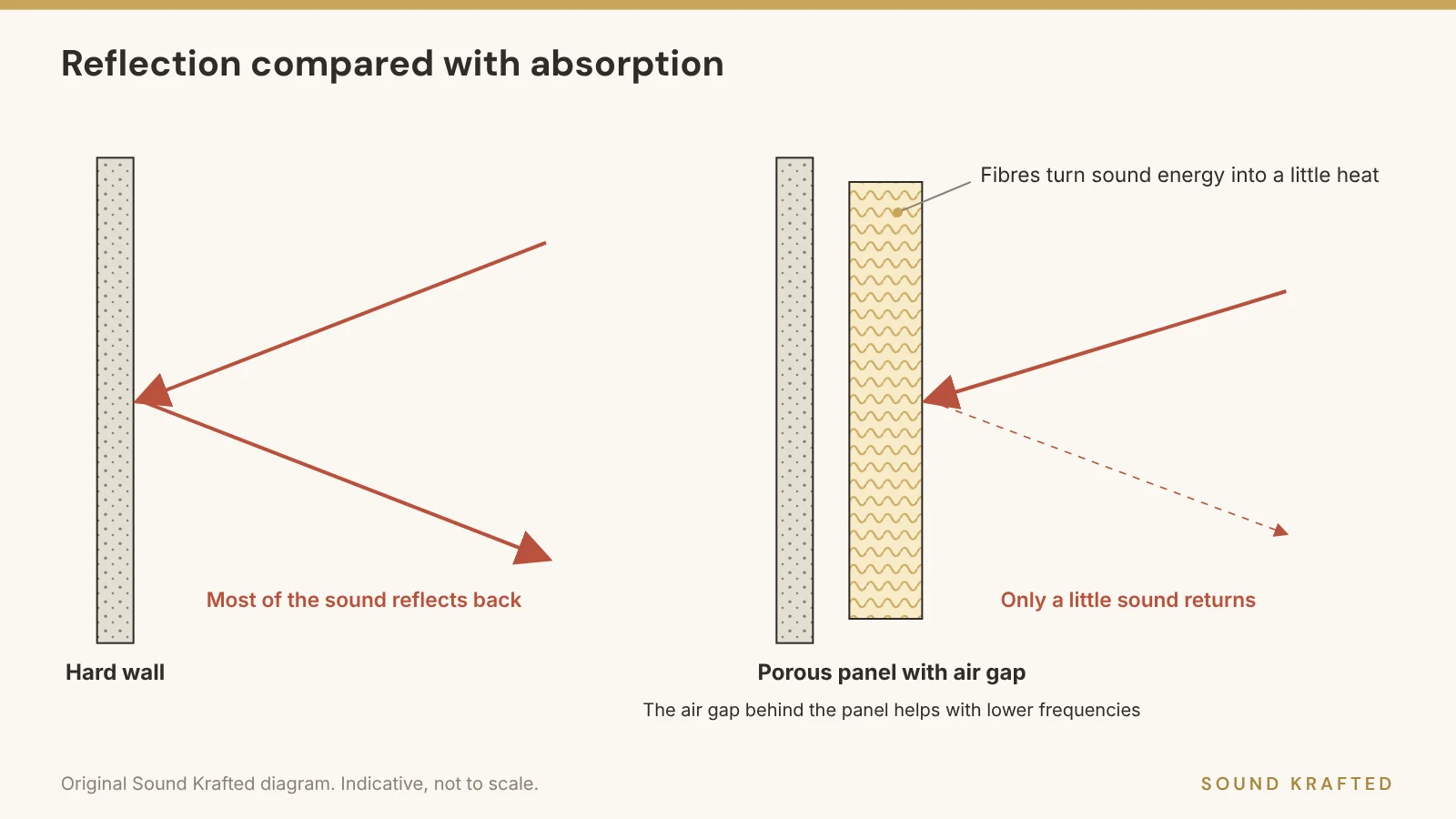
Sound is a pressure wave moving through air. When it enters a porous material such as mineral wool, glass wool or polyester fibre, the air moves through thousands of tiny passages and loses energy to friction. Less sound comes back out. Thicker panels, and panels spaced away from the wall, work down to lower frequencies, because the slower bass waves need more depth to be absorbed.
The ratings to ask for
- NRC (Noise Reduction Coefficient): a single number from 0 to about 1, the average absorption at 250, 500, 1000 and 2000 Hz. Tested to ASTM C423. Our NRC guide explains it in detail.
- αw and absorption class: the ISO 11654 rating used in European data sheets, with classes A (best) to E.
- Mounting: results depend on how the panel was tested. A panel tested with an air gap behind it will perform less well when fixed flat to a wall.
Thickness and mounting compared
| Panel build | Typical NRC | What it absorbs well |
|---|---|---|
| Acoustic foam, 25 mm, direct on wall | About 0.30 to 0.50 | Mainly high frequencies |
| PET (polyester) panel, 9 to 12 mm, direct on wall | About 0.20 to 0.40 | Mid and high frequencies |
| Fabric-wrapped mineral wool, 25 mm | About 0.60 to 0.80 | Speech frequencies |
| Fabric-wrapped mineral wool, 50 mm | About 0.85 to 1.0 | Speech and lower mid frequencies |
| 50 mm panel with an air gap behind it | High, with better low-frequency absorption | Rooms with boomy speech or music |
Indicative ranges from published laboratory tests; the BOQ lists tested data for the exact product and mounting.
Absorption is not soundproofing
An absorption panel on a shared wall will make your own room sound better, but your neighbour will still hear you. Stopping sound passing through a wall needs mass, airtight seals and decoupled construction. Our guides to acoustic foam vs acoustic panels and soundproofing a room from outside noise explain the difference with examples.
Choosing panels for your room
| Room | Usual choice | Where to place it |
|---|---|---|
| Meeting room or boardroom | Fabric-wrapped panels, 25 to 50 mm, and an acoustic ceiling | Ceiling first, then the wall opposite the screen |
| Open-plan office | Ceiling clouds or baffles, PET screens | Over desks and along hard walls |
| Classroom or lecture hall | Acoustic ceiling, rear-wall panels, durable PET low down | Ceiling and rear wall |
| Recording or podcast studio | Broadband panels with air gaps, bass traps | First reflection points, corners, rear wall |
| Auditorium or multi-purpose hall | Fabric or timber slat panels, rear-wall absorption | Rear wall and parts of the side walls |
Spread panels across several surfaces rather than grouping them on one wall. For a full layout method, see our acoustic panel placement guide.
Fire safety comes first
In offices, schools, halls and government buildings, absorption panels must carry suitable fire classifications for both the core and the facing. Standard polyurethane foam is not suitable for public buildings. Our guide to fire-rated acoustic panels explains what to ask for.
Our absorption panel work
We calculate the treatment area against a target reverberation time, prepare a layout and BOQ, and supply and fit the panels with our own team. Projects on our client list include acoustic treatment for Mukabbir University of Science & Technology, the Women Development Department, Punjab, and a conference room for the International Water Management Institute (IWMI) in Lahore. For ceilings, see acoustic ceilings; for Lahore projects, see acoustic panels in Lahore.
Frequently asked questions
What do sound absorption panels do?
They reduce echo and reverberation inside a room by absorbing part of the sound that hits them, so speech is clearer and the room is less noisy.
Do sound absorption panels block noise from neighbours?
No. They improve the sound inside your room but do not stop sound passing through walls, doors or ceilings. That needs soundproofing.
What NRC should I look for?
For speech rooms, panels around NRC 0.70 or higher are a good starting point. The right figure depends on the room and how much area you treat.
Is thicker always better?
Thicker panels absorb lower frequencies, which helps with boomy rooms. For most offices, 25 to 50 mm panels with a good acoustic ceiling are enough.
Do you publish panel prices?
No. Cost depends on the area, panel type, finish, fire data and fixing. Request a consultation or quote and we will send a layout and quotation.
Request a consultation or quote for absorption panels
Tell us about the room, the noise and the result you need. Call or WhatsApp +92 300 8467101 (Mon to Sat, 9 AM to 5 PM) or send the form, and we will reply with the next step.