
Short answer: An acoustic ceiling absorbs sound overhead, so rooms have less echo and clearer speech. Sound Krafted designs, supplies and installs acoustic ceiling tiles, ceiling clouds and baffles for offices, classrooms, halls and studios in Lahore and across Pakistan. An acoustic ceiling reduces echo inside a room; to stop noise from the floor above, you need a soundproof ceiling.
The ceiling is usually the largest uninterrupted surface in a room, which makes it the most effective place to add sound absorption. Offices, classrooms, meeting rooms and halls with hard plaster or gypsum ceilings often sound loud and echoey for this reason. This page compares the three main acoustic ceiling types, explains the ratings to ask for and shows where each one fits.
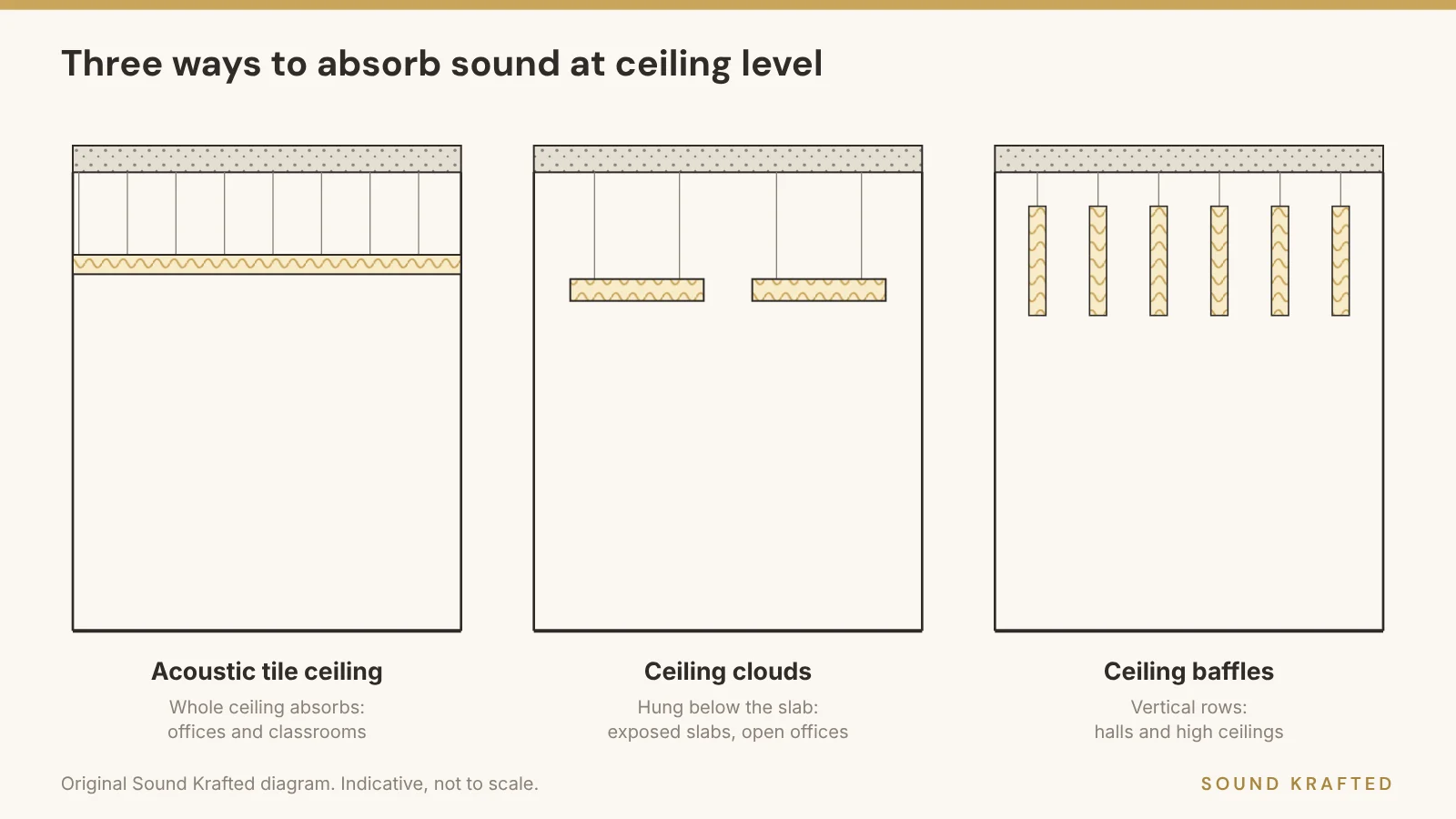
Which type of acoustic ceiling fits your room?
| Type | How it works | Typical NRC | Best for |
|---|---|---|---|
| Acoustic ceiling tiles in a grid | Mineral fibre or glass wool tiles replace hard tiles across the whole ceiling | About 0.55 to 0.95, by product and thickness | Offices, classrooms, corridors, clinics |
| Ceiling clouds | Flat absorbent panels hung below the slab, often over desks or seating | High, as both faces absorb | Open offices, meeting rooms, rooms with exposed slabs |
| Ceiling baffles | Vertical absorbent panels hung in rows | High per panel; set by spacing | Halls, atriums, sports and high ceilings |
| Timber slat or perforated ceiling | Slats or perforated boards over an absorbent backing | Often 0.60 to 0.90, set by the backing | Auditoriums, lobbies, boardrooms |
Indicative ranges from published laboratory tests (ISO 354 or ASTM C423); the BOQ lists tested data for the exact product and mounting depth.
Acoustic ceiling or soundproof ceiling?
The two are often confused. An acoustic ceiling absorbs sound inside the room: it reduces echo and makes speech clearer. A soundproof ceiling stops sound passing between floors: footsteps, voices or music from above. It needs mass, an airtight build and decoupling from the slab. If your problem is noise from upstairs, see soundproofing ceilings and our guide to reducing footstep noise from upstairs. Many rooms need both, and they can be built together.
How much of the ceiling needs treatment?
We size the treatment from the room volume, the hard surfaces already present and the use of the room, against a target reverberation time (ISO 3382). A classroom or meeting room usually needs most of the ceiling to be absorbent. In a hall, ceiling treatment is combined with rear-wall absorption and, where music is important, some diffusion. Our guide to reverberation time and speech clarity explains the targets.
Fire, light and services
- Fire performance: ceilings in public buildings need tested materials. Ask for the classification of the complete product, such as EN 13501-1 or ASTM E84, and keep the reports. See fire-rated acoustic panels and test reports.
- Lights, diffusers and sprinklers: we coordinate the ceiling layout with lighting, air conditioning grilles, smoke detectors and access panels.
- Light reflectance: white or light finishes keep rooms bright, which suits the light gold and white interiors many offices prefer.
- Humidity: for kitchens, pools or semi-open areas we choose moisture-resistant tiles and fixings.
What our acoustic ceiling work includes
- Survey: room size, ceiling height, slab, services and existing finishes.
- Design and BOQ: ceiling type, area, layout and fire data.
- Supply and installation by our own team, coordinated with your electrical and air conditioning contractors.
- Handover: a check against the agreed target and simple care notes.
Projects with acoustic ceilings
Acoustic ceilings were part of the turnkey auditorium for the Punjab Education Foundation, and of acoustic treatment projects for Mukabbir University of Science & Technology and the Women Development Department, Punjab, in Lahore. Working since 2021, we have delivered 50 projects for 49 organisations; see the client list. For wall treatment alongside the ceiling, see acoustic panels in Pakistan and sound absorption panels.
Frequently asked questions
What is an acoustic ceiling?
A ceiling made from sound-absorbing tiles, clouds, baffles or slatted panels. It reduces echo inside the room so speech is clearer and the room feels quieter.
Does an acoustic ceiling stop noise from the floor above?
Not on its own. Absorbent tiles reduce echo in the room. To stop footsteps or voices from above, you need a soundproof ceiling with mass, airtight joints and decoupling.
Can acoustic tiles replace the tiles in our existing grid?
Often yes, if the grid is sound and the size matches. We check the grid, the plenum and the fire requirements at the survey.
Are acoustic ceilings safe in public buildings?
Yes, when the products carry suitable fire classifications. We specify tested materials and keep the reports in the handover file.
Do you publish acoustic ceiling prices?
No. Cost depends on area, product, height, services and fire needs. Request a consultation or quote and we will send a layout and quotation.
Request a consultation or quote for an acoustic ceiling
Tell us about the room, the noise and the result you need. Call or WhatsApp +92 300 8467101 (Mon to Sat, 9 AM to 5 PM) or send the form, and we will reply with the next step.