
The short answer: footstep noise from upstairs is impact noise that travels as vibration through the slab, so the best fix is at the floor above: carpet or a floating floor. If you cannot change that floor, an isolated ceiling on resilient fixings, with insulation and damped double board, reduces it below. Ordinary false ceilings and acoustic panels do very little.
Thumping footsteps, dragged chairs and children running upstairs are among the most common complaints in flats, hostels, hotels and offices in Lahore, Islamabad and Karachi. The chhat (ceiling) feels solid, so people are surprised that it lets so much through. This guide explains why, and what actually works.
Why do footsteps come through a concrete slab?
There are two kinds of noise from above, and they need different treatment:
| Type | Examples | How it travels | How it is rated |
|---|---|---|---|
| Airborne | Voices, TV, music | Sound waves hit the slab and set it vibrating | STC or Rw: higher is better |
| Impact | Footsteps, dropped objects, chairs, furniture | Direct strikes vibrate the slab itself | IIC: higher is better; or L’n,w: lower is better |
A typical 125 to 150 mm RCC slab blocks speech reasonably well, but carries impact noise very efficiently. A bare slab with tiles can have an IIC as low as about 25 to 35, which means footsteps are clearly heard below. The US International Building Code, for example, sets IIC 50 (45 when tested on site) between homes, and IIC 55 to 60 or more is comfortable. See the general IIC explainer for background on the rating.
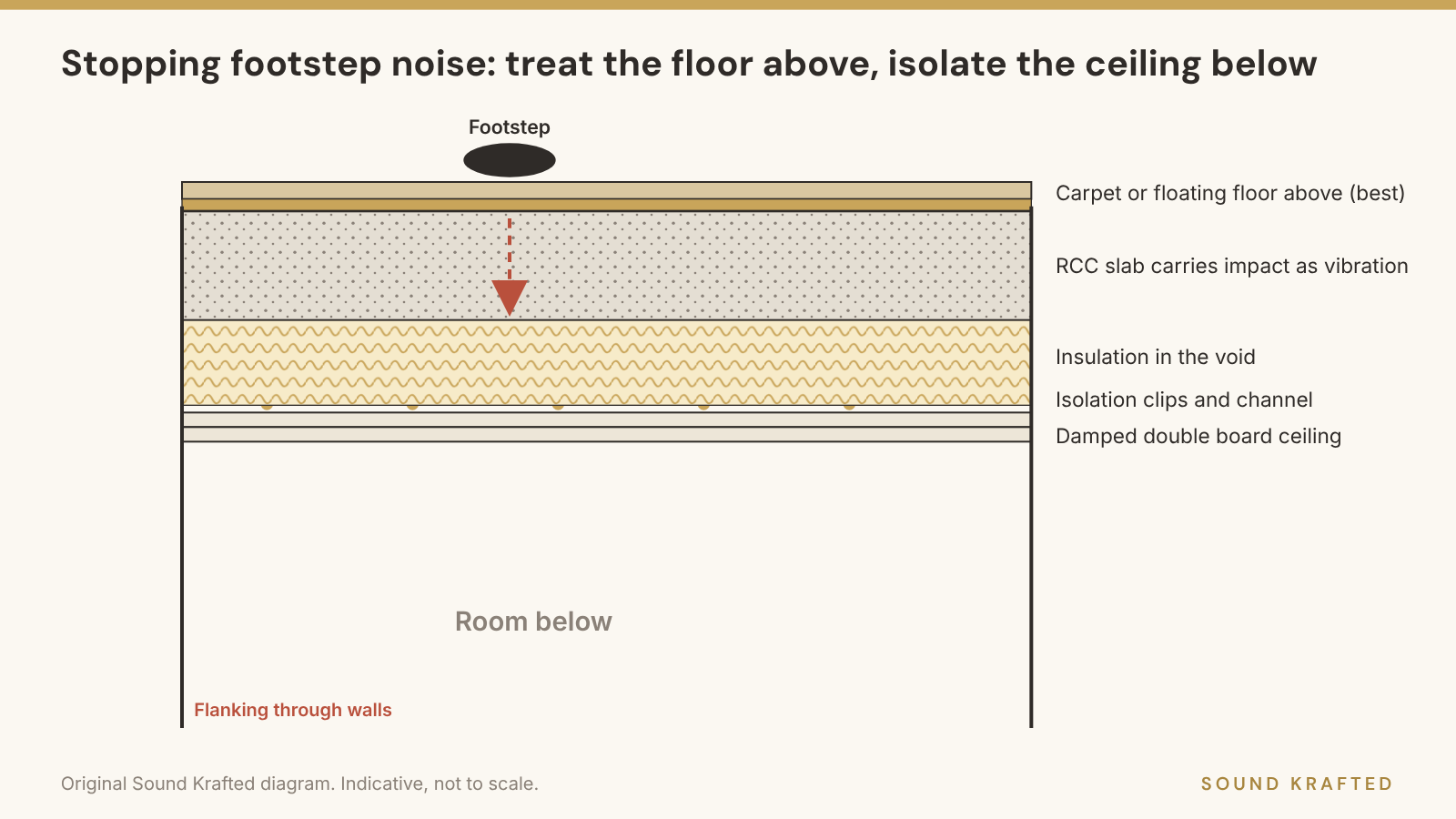
Should you treat the floor above or the ceiling below?
Treat the floor above where you can, the ceiling below where you cannot, and both for the best result.
Option 1: treat the floor above (best)
Stopping the impact before it enters the slab is the most effective approach.
| If upstairs is… | Usually the best choice |
|---|---|
| An office or corridor you can influence | Carpet tiles on a good backing |
| A flat being refurbished | A floating floor or an acoustic underlay under the new finish |
| A rented flat you cannot change much | Rugs, felt pads and soft furniture feet as a first step |
Whatever the floor, keep it isolated from the walls with an edge strip and flexible sealant, or the vibration bypasses the resilient layer. Our floating floor build-ups page shows the options in detail, and our carpet tiles and flooring range covers the finishes.
Option 2: build an isolated ceiling below
When the upstairs neighbour, landlord or another department controls the floor above, treat the ceiling below. A soundproof ceiling is not the same as a normal false ceiling:
- It hangs on isolation clips and channel or resilient hangers, not rigid wires or direct fixings.
- It uses two layers of dense gypsum board with damping compound between them.
- The void holds mineral wool or glass wool to stop it ringing (see rock wool vs glass wool for soundproofing).
- The edges are sealed with acoustic sealant, and light fittings are boxed or chosen to avoid holes.
| Concrete slab situation | Typical impact rating |
|---|---|
| Bare 150 mm RCC slab with tiles | IIC about 25 to 35 |
| Decoupled, insulated, damped double board ceiling below | Typically raises IIC by about 10 to 20 points |
| Carpet on a good underlay above | Can raise IIC by 30 points or more |
| Floating screed on a tested resilient layer | Typically IIC 55 to 65 |
Indicative ranges from published laboratory tests; confirmed by survey; the BOQ lists tested data for the exact product or system. Our ceiling soundproofing page explains each level.
Option 3: deal with flanking
Even with a good ceiling, vibration can travel down the walls and columns that connect the two floors. This flanking path limits the result. Independent wall linings in the room below (see how to plan a soundproof partition wall), sealed junctions and soft fixings for any heavy items help. In hotels and new apartment blocks, the best results come when isolation is planned at design stage.
What does not work for footstep noise?
- Acoustic panels on the ceiling. They absorb echo inside your room but do not stop vibration coming through the slab.
- A standard gypsum or tile false ceiling. It is light, rigidly hung and full of openings. It may even resonate.
- Foam glued to the slab. No mass, no isolation, and a fire risk.
- Filling the ceiling void with insulation alone. It helps a little but cannot replace a decoupled, heavy ceiling.
Practical steps for flats and offices
- Talk to the people upstairs. Felt pads under chair legs, rugs and soft-soled indoor shoes cost little.
- For offices, ask the building management about carpet tiles on the floor above, especially in corridors and busy areas.
- If you control the floor above, lay a floating floor or carpet on a quality underlay.
- If you only control your room, install a decoupled, damped ceiling with insulation.
- Seal gaps where pipes and cables pass through the slab.
What shapes the cost
Instead of prices, here are the cost factors: room area, ceiling height available, whether the floor above can be treated, the build-up level chosen, light fitting and AC changes, access and working hours, and the finish required. A survey shows which option gives the best result for your building.
Remember the difference: an acoustic ceiling reduces echo in your room, while a soundproof ceiling stops noise from above. For local help, see room soundproofing in Lahore.
Frequently asked questions
Why can I hear footsteps through a concrete slab?
Concrete carries vibration very efficiently. Each step vibrates the slab, which then radiates sound into the room below. Mass alone does not stop impact noise; isolation does.
Is it better to treat the floor above or the ceiling below?
The floor above, because it stops the impact entering the slab. Where that is not possible, a decoupled ceiling below is the next best option. The best results come from treating both.
How much ceiling height will I lose?
A decoupled ceiling typically needs about 75 to 100 mm in total, including clips, channel and two boards, and more where a deeper insulated void is used. We confirm it in the design.
Will carpet tiles stop footstep noise in offices?
Carpet tiles with a good backing greatly reduce footfall noise in offices and control rooms, and they are easy to replace tile by tile.
Do acoustic panels help with footsteps?
No. They reduce echo inside your room but do not stop vibration through the slab.
Get a quieter room below
Tell us what you hear, how the floor above is used and whether it can be treated. Our team will survey and recommend the right build-up. Request a site survey and BOQ, or call or WhatsApp +92 300 8467101.
About the author: Sound Krafted Acoustics Team. Sound Krafted designs and builds soundproofing and acoustic treatment for government departments, universities, broadcasters and companies across Pakistan. Working since 2021, with 50 projects for 49 organisations. Main Jinnah Park, Harbanspura, Lahore 54850. Mon to Sat, 9 AM to 5 PM. info@soundkrafted.com, +92 300 8467101.