
The short answer: when choosing between rockwool vs glass wool for soundproofing, both work well inside a soundproof wall or ceiling, because their job is to damp the cavity, not to block sound alone. Rock wool (often called Rockwool, which is a brand name) handles heat better, so it suits plant rooms and fire-rated walls. Glass wool is lighter and suits ordinary partitions.
That is the decision in a sentence. The rest of this guide explains why, where each one fits in buildings in Lahore, Islamabad and Karachi, and the mistakes we see most often on site.
What insulation actually does in a soundproof wall
A soundproof wall stops sound with four things working together: mass, decoupling, damping and sealing. Insulation is a fifth helper. When sound hits one face of a framed wall, the air in the cavity behaves like a spring. Without anything in the cavity, sound builds up between the boards and passes to the other side. Fibrous insulation absorbs that energy and damps the cavity resonances.
In laboratory tests, filling the cavity of a framed gypsum wall typically adds about 3 to 8 STC points (Sound Transmission Class), more in steel stud and decoupled walls than in rigid timber stud walls. That is useful, but it is not the main event. A thick roll of insulation behind a single sheet of board will not make a room quiet. The board layers, the frame and the seals do most of the work.
So the first lesson is simple: the choice between rock wool and glass wool matters less than the wall build-up around it. Choose the wall first, then the insulation.
What are rock wool and glass wool?
Both are mineral wools. Rock wool is spun from molten volcanic rock such as basalt. Glass wool is spun from molten glass, often with recycled glass content. In Pakistan both are widely sold as rolls, batts and rigid slabs, and installers often call them “wool” or simply “insulation”. Local sellers usually list them by density and thickness, so it helps to know what those numbers mean.
Side-by-side comparison
| Property | Rock wool | Glass wool |
|---|---|---|
| Typical density for acoustic use | About 40 to 100 kg/m³ slabs | About 10 to 48 kg/m³ rolls and boards |
| Absorption (NRC), 50 mm, mounted directly on a hard surface | Typically 0.85 to 1.0 | Typically 0.80 to 0.95 |
| Low-frequency help | Similar at the same thickness; thickness and air gap matter more than density | Similar at the same thickness; use the full cavity depth |
| Heat tolerance | Very high; often used in fire-rated walls | Lower; check the product’s fire data |
| Handling | Stiffer slabs, friction-fit well between studs | Lighter, compresses for transport, itchy without PPE |
| Moisture | Water-repellent grades available | Water-repellent grades available |
| Best fit | Plant rooms, generator rooms, cinemas, fire-rated walls | Office partitions, ceilings, large areas |
Indicative ranges from published laboratory tests; the BOQ lists tested data for the exact product or system.
Does higher density mean better soundproofing?
Higher density is not always better for sound. In a stud wall cavity, light glass wool and dense rock wool give results within a point or two of each other in most tests. The difference grows in three situations:
- Bass-heavy rooms. Home cinemas, music rooms and rooms next to generators deal with low frequencies. Thicker insulation and a wider cavity help most here; the choice of rock wool or glass wool makes little difference.
- Free-standing absorbers. When insulation is the core of an acoustic panel or bass trap, density changes the absorption curve. For panels, 40 to 80 kg/m³ is a common range.
- Over-packed cavities. Squashing thick insulation into a narrow cavity can bridge the two sides of a wall. Choose a thickness that fills the cavity without forcing it.
Which is safer in a fire, rock wool or glass wool?
Fire safety is where the two materials differ most. Rock wool keeps its form at very high temperatures, so it is the usual choice for fire-rated partitions, plant rooms, shafts and anywhere the building’s fire plan asks for a non-combustible core. Many unfaced glass wool products are also classed A1 or A2 (non-combustible or limited combustibility) to BS EN 13501-1, but they soften at a much lower temperature than rock wool, and the binder and any facing (foil or paper) change the classification.
For public buildings, schools, hospitals and government offices, ask for the fire classification of the exact product, tested to BS EN 13501-1 or ASTM E84, and keep the reports on file. Do not accept a general claim that “wool does not burn”. Our guide to fire rated acoustic panels and their test reports explains how to check a report.
Handling, health and site practice
Both materials release fibres when cut. Installers should wear gloves, long sleeves, eye protection and a dust mask, and the room should be cleaned before finishing. Glass wool tends to irritate the skin more; rock wool slabs cut more cleanly with a long knife. In occupied offices in Lahore or Rawalpindi, we cut materials outside the work area where possible and bag offcuts the same day.
Keep insulation dry during storage. Monsoon humidity and roof leaks can soak an open roll, and wet insulation sags and loses performance.
Which one should you choose?
| Your situation | Our usual choice | Why |
|---|---|---|
| Office or cabin partition | Glass wool, 50 to 75 mm | Easy to fit, good absorption, lighter on the ceiling grid |
| Soundproof ceiling below a slab | Glass wool or light rock wool | Low weight on the hangers matters |
| Generator room or plant room wall | Rock wool slab | Heat tolerance and density |
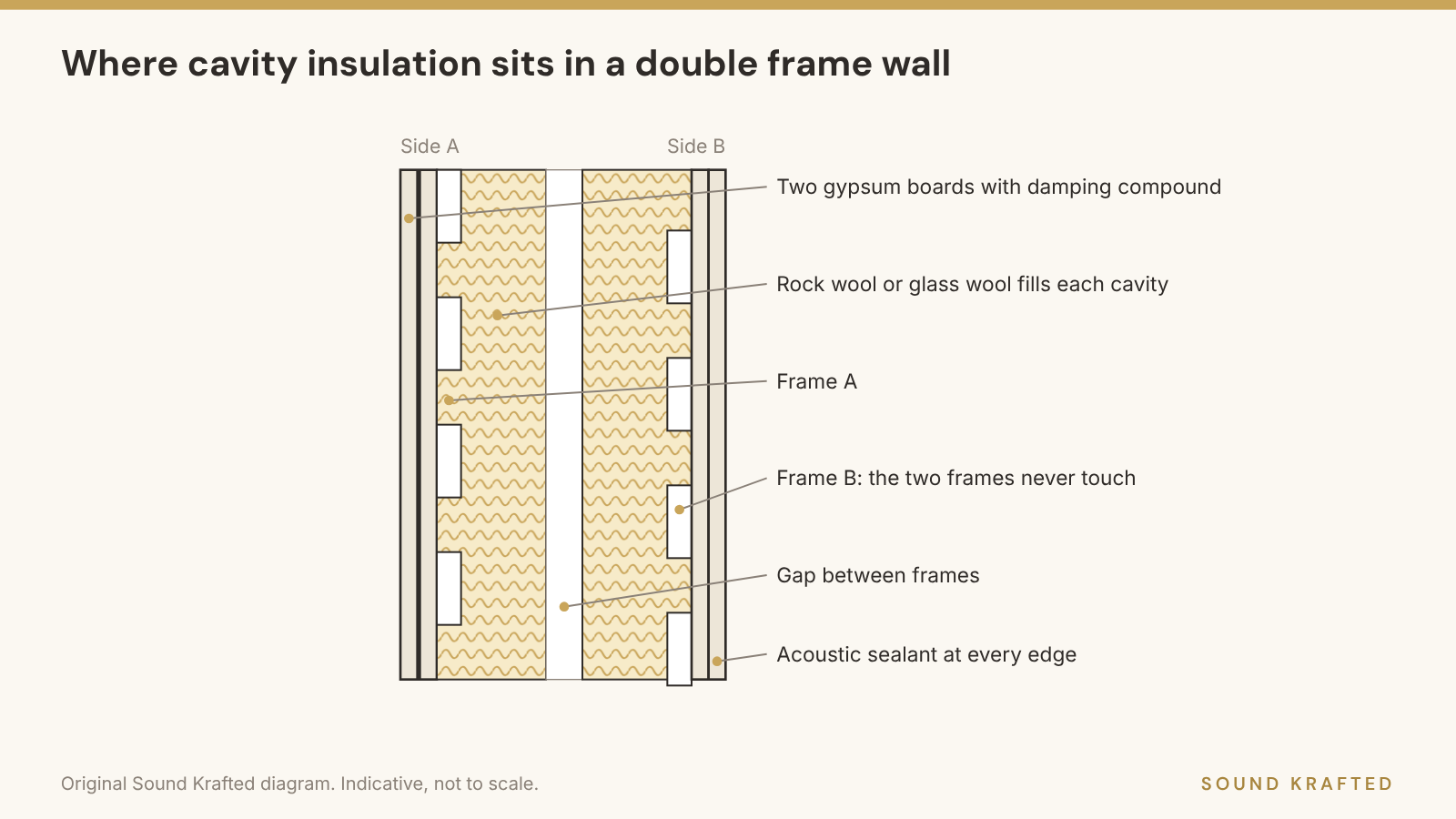
| Home cinema or music room | Rock wool or glass wool, full cavity, in a double frame wall | The decoupled frame and wide cavity control bass; the wool type matters little |
| Fire-rated partition | Rock wool, as named in the tested system | Must match the fire test |
| Acoustic panel core | Rigid rock wool or dense glass wool board | Stable shape, predictable absorption |
Common mistakes we see in Pakistan
- Insulation without a proper wall. Wool stuffed behind a single board, with gaps at the ceiling, gives little improvement.
- Stopping at the false ceiling. A partition that ends at the false ceiling lets sound pass over the top, whatever insulation is inside. See how to plan a soundproof partition wall between offices.
- Wrong product in a fire-rated wall. Swapping the tested insulation for a cheaper one can void the fire rating.
- Foam used as cavity fill. Packing foam into a wall cavity does not replace mineral wool and adds fire risk.
- Gaps around sockets and pipes. Small holes leak a surprising amount of sound. Acoustic sealant and putty pads fix them.
How Sound Krafted specifies insulation
On every job we start with the noise problem and the target rating, then design the wall or ceiling, and only then choose the insulation. Our wall soundproofing build-ups and ceiling soundproofing levels show where the cavity insulation sits in each system. For a wider look at materials and their ratings, read our guide to commercial soundproofing materials and STC ratings.
Our recent work on walls, ceilings and rooms includes the turnkey auditorium for the Punjab Education Foundation, which combined soundproofing, acoustic ceilings and soundproof doors, and the conference room treatment for the International Water Management Institute in Lahore.
Where this choice matters most: inside the walls of a studio. See recording studio soundproofing for how we build them, or room soundproofing in Lahore for local projects.
Frequently asked questions
Is rock wool better than glass wool for soundproofing?
Not by much inside a normal stud wall. Both absorb sound in the cavity well. Rock wool is denser and more heat resistant, so it is the better choice for plant rooms and fire-rated walls. For bass-heavy rooms, cavity depth and decoupling matter more than the wool type.
What thickness of insulation should I use?
Match the cavity. In a typical metal stud wall, 50 to 75 mm fills the space without squashing. In a double-frame wall, fill both cavities or use a thicker slab, without bridging the two frames.
Does insulation alone soundproof a room?
No. Insulation helps a wall perform, but the soundproofing comes from mass, decoupled framing, damping layers and airtight sealing. Doors and windows usually need attention too.
Is glass wool safe in a ceiling?
Yes, when it is installed with proper PPE, kept dry and enclosed behind board or fabric. For public buildings, check its fire classification and keep the test report.
Can I use acoustic foam instead of mineral wool?
Not inside walls. Foam is an absorber for room surfaces, not a cavity insulation, and many foams have poor fire performance.
Talk to us about your wall or ceiling
Tell us what you are hearing and where it comes from. Our team will visit, set a target rating and prepare a design and BOQ with options. Request a site survey and BOQ, or call or WhatsApp +92 300 8467101.
About the author: Sound Krafted Acoustics Team. Sound Krafted designs and builds soundproofing and acoustic treatment for government departments, universities, broadcasters and companies across Pakistan. Working since 2021, with 50 projects for 49 organisations. Main Jinnah Park, Harbanspura, Lahore 54850. Mon to Sat, 9 AM to 5 PM. info@soundkrafted.com, +92 300 8467101.