
The short answer: soundproof windows price in Pakistan depends on the noise reduction you need, the glass build-up, the gap between panes, the frame and seals, the size and opening type, and installation. A bedroom window around STC 35 costs much less than a studio window above STC 45 facing a main road.
Window enquiries are common as roads get busier and more homes and offices sit beside generators and commercial areas. We do not publish window prices because the same size of khirki (window) can be specified in many ways. This guide explains what changes the quote, so you can compare offers on performance, not just on glass thickness.
If you want the technical comparison between glass types first, read our article on acoustic glazing vs double glazing. This guide focuses on cost. For a step-by-step plan covering doors and vents as well, see how to soundproof a room from outside noise.
Cost factor 1: how much noise reduction do you need?
The biggest driver of cost is how much noise reduction you need. Start with the noise source and the room use.
| Typical window build-up | Typical rating range | Good for |
|---|---|---|
| Single 5 to 6 mm glass in a sliding frame | About STC 25 to 28 | Not suitable for noisy sites |
| Standard double glazing, equal panes, small gap | About STC 28 to 33 | Thermal comfort; limited noise gain |
| Laminated acoustic glass, single pane | About STC 34 to 38 | Bedrooms and offices on moderate roads |
| Acoustic double glazing, laminated panes of different thickness | About STC 38 to 42 | Busy roads, offices, classrooms |
| Secondary glazing with a 100 mm or wider gap | About STC 45 or more | Studios, control rooms, very noisy sites |
Ratings are for complete windows, not glass alone. Indicative ranges from published laboratory tests; the BOQ lists tested data for the exact product or system. STC and Rw are speech-weighted ratings. For traffic, generator or cinema bass, also ask for Rw + Ctr or OITC, or the 63 and 125 Hz test data, because these show low-frequency performance. The STC explainer gives background on the scale. Higher targets need heavier glass, wider gaps and better frames, which all add cost.
Cost factor 2: glass type and thickness
- Laminated acoustic glass has a special interlayer that damps vibration. It performs better than ordinary glass of the same weight and also improves safety and security. See this general note on laminated glass.
- Different pane thicknesses in double glazing avoid both panes resonating at the same frequency.
- Thicker glass adds mass and performance, but also weight, which affects the frame and hardware.
- Coatings for heat and glare (low-E, solar control) add cost but help in Pakistan’s summers.
Cost factor 3: does the gap between panes matter?
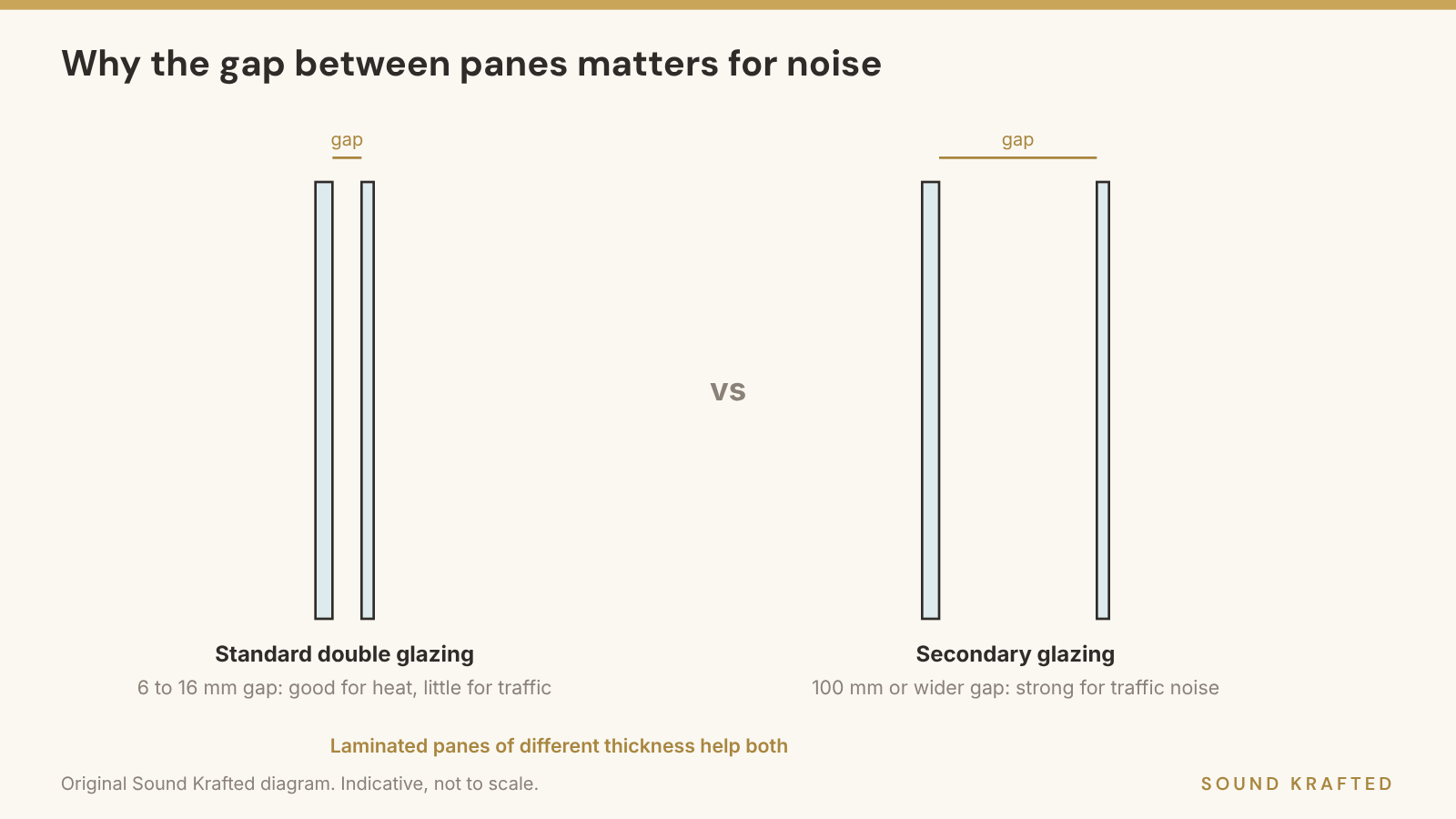
In double glazing, a small gap of 6 to 16 mm is good for heat but gives limited sound benefit. With a small gap, the two panes and the air between them resonate at around 200 to 300 Hz, right in the traffic range, so a sealed unit can perform little better than a single pane of the same total weight. Gaps of 100 mm or more, usually as secondary glazing, give much better isolation, especially for low-frequency traffic noise. Wider gaps need deeper frames or a second window line, which adds cost.
Cost factor 4: which frames seal best?
| Frame type | Acoustic notes |
|---|---|
| uPVC with multi-chamber profile and compression seals | Good sealing, widely available |
| Thermally broken aluminium with compression seals | Strong, slim sight lines, good for large panes |
| Timber or steel in studios and observation windows | Custom, heavy, very well sealed |
| Standard sliding aluminium | Hard to seal; usually the weak point |
The opening type matters too. Fixed windows seal best. Tilt-and-turn and casement windows with compression seals perform well. Sliding windows are hardest to seal and usually limit the result.
Cost factor 5: size, shape and quantity
Large panes need thicker glass and stronger frames. Non-standard shapes, arches and very tall windows cost more to make and fit. Ordering several windows of the same size usually lowers the cost per window.
Cost factor 6: installation and the wall
- Removal of old windows and making good the opening.
- Sealing the frame to the wall with acoustic sealant and backing rod; a gap here undoes good glass.
- Access: high-rise buildings, scaffolding or rope access add cost.
- Working hours: occupied offices, hospitals or government buildings may need out-of-hours work.
- Location: projects in Islamabad, Rawalpindi, Faisalabad or Karachi include transport and travel.
Cost factor 7: ventilation
A sealed window stops noise, but rooms still need fresh air. Acoustic trickle vents, attenuated air paths or mechanical ventilation keep the room comfortable without opening the window. These add to the cost but are often essential.
What if windows alone are not enough?
If the wall itself is thin, or the noise is very low frequency (heavy trucks, generators), windows are only part of the answer. Sound Krafted also provides generator noise control at the source, including enclosures, silencers and anti-vibration mounts. See our guide to generator noise attenuation.
How to get a fair window quote
- Describe the noise: road traffic, generator, neighbours, aircraft, or a mix.
- Agree a target rating for each room.
- List each window with size, opening type and floor level.
- Ask for the tested rating of the complete window, not just the glass.
- Check that sealing to the wall and ventilation are included.
- Compare suppliers on performance and installation detail, not just glass thickness.
Our window work
Sound Krafted supplies and fits acoustic glazing and acoustic windows for studios, control rooms, observation windows, offices and rooms facing busy roads, as part of our soundproof doors and acoustic windows service. We design windows together with the walls and doors so the room performs as a whole. For doors, see our guide to soundproof door cost factors.
Facing a main road in Lahore? See soundproofing in Lahore for how we survey and fix street noise, starting with windows and doors.
Frequently asked questions
Why do soundproof window quotes vary so much?
Because glass type, gap width, frame, seals, opening type, size and installation can all change. Two windows with the same glass thickness can perform very differently.
Is double glazing the same as soundproof glazing?
No. Standard double glazing with two equal panes and a small gap is designed for heat. Soundproof glazing uses laminated acoustic glass, different pane thicknesses or wide gaps.
Can I keep my existing windows and add secondary glazing?
Yes. A second, well-sealed window line on the inside, with a wide gap, is often one of the most effective upgrades for very noisy sites.
Do soundproof windows also keep the room cooler?
Often. Double glazing and solar control or low-E coatings reduce heat gain, and sealed frames keep out dust. Single laminated glass on its own does little for heat, though it blocks most UV.
How long does installation take?
A typical room is often completed in a day or two once the windows are made. Larger buildings are scheduled floor by floor.
Get a window quotation
Send us photos, sizes and a short description of the noise, or ask us to survey. We will quote with options by performance. Request a site survey and BOQ, or call or WhatsApp +92 300 8467101.
About the author: Sound Krafted Acoustics Team. Sound Krafted designs and builds soundproofing and acoustic treatment for government departments, universities, broadcasters and companies across Pakistan. Working since 2021, with 50 projects for 49 organisations. Main Jinnah Park, Harbanspura, Lahore 54850. Mon to Sat, 9 AM to 5 PM. info@soundkrafted.com, +92 300 8467101.