
The short answer: how to soundproof a room from outside noise comes down to its weakest points: windows, doors, air gaps and vents, seldom a solid brick wall. Seal the gaps, fit acoustic glazing, add a sealed solid door and treat the vents. Only then line any wall that still leaks. Generator noise is best reduced at the source.
Lahore’s main roads, rickshaws, wedding bands, rooftop generators, neighbours’ parties and the call of a busy bazaar all reach inside our homes and offices. The good news is that most rooms can be made much quieter without rebuilding them, if the work is done in the right order.
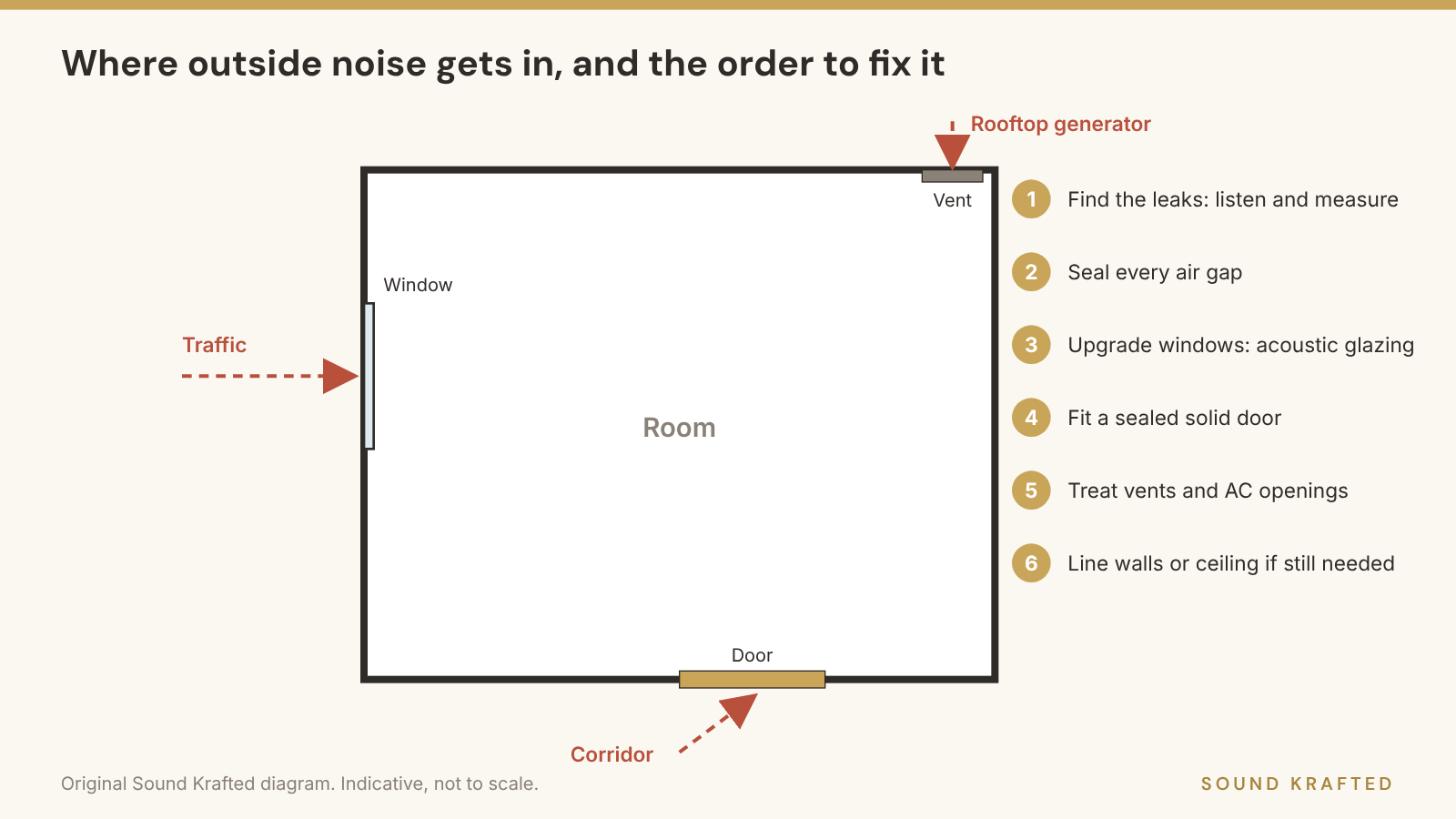
Where does outside noise get into a room?
Step 1 is to find the leaks. Stand in the room at the noisy time of day and listen. Close your eyes and turn your head slowly; you will usually find the noise is loudest near one window, the door or an AC opening. Then check these common leaks:
| Leak | How to spot it | Typical fix |
|---|---|---|
| Window gaps | Light or draught around the sash; rattling | Acoustic seals, or new sealed frames |
| Single glass | Noise loudest at the glass | Laminated acoustic glass or secondary glazing |
| Door gap | Light under the door; noise from the corridor | Drop seal and perimeter seals, or a solid acoustic door |
| Exhaust fans and vents | Noise loudest at the grille | Acoustic louvre, baffle box or lined duct |
| Split AC pipe hole | Gap around the pipes | Seal with acoustic sealant and putty |
| Thin roof or top-floor slab | Rain, aircraft and rooftop noise from above | Insulated, decoupled ceiling |
| Lightweight wall | Noise through the whole wall | Independent lining with mass and insulation |
A professional survey adds sound level measurements so we can set a target and check the result.
Why seal the air gaps first?
Step 2 is sealing. Sound travels wherever air can. A gap of only a few millimetres around a window or door can undo the benefit of thick glass or heavy walls. Use non-hardening acoustic sealant around frames, foam or rubber compression seals on opening windows, and putty pads behind sockets on external walls. This step costs little and often gives a noticeable improvement on its own.
Which windows stop traffic noise?
Step 3 is the windows. Windows are the biggest leak in most rooms facing a road. Standard single glass in a sliding aluminium frame gives poor isolation, and sliders rarely seal well.
| Window option | Typical rating (complete window) | Comment |
|---|---|---|
| Existing single glass with new compression seals | About STC 26 to 30 | Quick first step; seals limit the leaks, not the glass |
| Laminated acoustic glass, about 6.8 to 10.8 mm, sealed frame | About STC 34 to 38 | Damped glass, good upgrade |
| Secondary glazing with a 100 mm or wider gap | About STC 45 or more | Strong option for very noisy sites |
Indicative ranges from published laboratory tests; the BOQ lists tested data for the exact product or system. STC and Rw are speech-weighted ratings. For traffic, generator or cinema bass, also ask for Rw + Ctr or OITC, or the 63 and 125 Hz test data, because these show low-frequency performance. For the full range of window options and what shapes their cost, see what shapes the cost of soundproof windows. The frame, seals and installation matter as much as the glass. Sound Krafted supplies and fits acoustic glazing; our article on acoustic glazing vs double glazing explains why ordinary double glazing often disappoints for traffic noise.
How much does the door matter?
Step 4 is the door. A hollow internal door with a large gap underneath lets corridor and street noise straight in. A solid-core door with compression seals and an automatic drop seal is a big step up; a dedicated acoustic door with a tested rating is better still. See our soundproof doors and acoustic windows, and our guide to soundproof door cost factors.
How do you keep vents quiet?
Step 5 is ventilation. Rooms need fresh air. Rather than blocking vents, fit acoustic louvres, lined baffle boxes or short lined duct runs that let air through but absorb sound. Make sure split AC pipe holes and any old window AC openings are closed with heavy, sealed infill.
When do walls and ceilings need work?
Step 6 comes last. If the noise still comes through the wall after the openings are fixed, add an independent lining: a separate frame set at least 50 mm off the wall (more is better), mineral wool, and two layers of dense board with damping compound. On a typical brick wall this usually adds about 8 to 15 points in the mid frequencies, and less at low frequencies. Top-floor rooms with rain and rooftop noise may need an insulated, decoupled ceiling; for noise from the floor above, see footstep noise from upstairs. Our wall soundproofing page shows the build-ups.
How do you stop generator noise?
Generators are a special case because they produce strong low-frequency noise and vibration. Treating the room helps, but treating the generator is usually more effective. Sound Krafted offers generator noise control, including acoustic enclosures, attenuated air paths, exhaust silencers and anti-vibration mounts. Our guide to generator noise attenuation covers the options, and our industrial soundproofing service handles plant and generator rooms. If the generator belongs to a neighbour, discuss moving it, enclosing it or turning the exhaust away from your windows.
What realistic results look like
Most rooms facing a busy road can be made comfortable for work and sleep with sealed acoustic glazing, a better door and treated vents. Very low-frequency sounds such as heavy trucks, bass music and generators are the hardest to stop completely. For traffic, compare windows on Rw + Ctr or OITC, not STC alone. A survey sets a realistic target before any money is spent. The WHO environmental noise guidelines explain why lower night-time noise matters for health and sleep.
What not to do
- Do not cover walls in foam to stop outside noise. Foam absorbs echo inside the room; it does not block sound coming through.
- Do not block all ventilation; it causes damp and poor air.
- Do not buy “soundproof” curtains expecting big results. Heavy curtains help a little with high frequencies and echo only.
- Do not upgrade walls before windows and doors. The weakest point usually limits the result.
Based in Lahore? Our page on soundproofing in Lahore covers local surveys and projects, and soundproof doors explains door ratings in detail.
Frequently asked questions
What is the cheapest way to reduce outside noise?
Seal the gaps. Acoustic sealant around frames, compression seals on windows and a drop seal on the door often give a clear improvement for very little cost.
Do soundproof windows really work for traffic noise?
Yes, when the glass is laminated acoustic glass or secondary glazing with a wide gap, and the frame is well sealed. Ordinary double glazing with two equal panes helps less than people expect.
Can I soundproof a rented room?
Partly. Window seals, a door drop seal, secondary glazing on removable frames and heavy curtains can all be fitted without major work.
How do I stop generator noise from next door?
Upgrade the windows facing the generator first. The best result comes from an acoustic enclosure and silencer on the generator itself.
Will soundproofing block mobile signals or Wi-Fi?
Normal soundproofing materials do not block signals noticeably. Some metal-coated glass (low-E or solar control) can reduce mobile signal noticeably; we check this during specification.
Book a noise survey
Tell us what you hear, when, and where it comes from. Our team will visit, measure and recommend the fixes in order of value. Request a consultation or quote, or call or WhatsApp +92 300 8467101.
About the author: Sound Krafted Acoustics Team. Sound Krafted designs and builds soundproofing and acoustic treatment for government departments, universities, broadcasters and companies across Pakistan. Working since 2021, with 50 projects for 49 organisations. Main Jinnah Park, Harbanspura, Lahore 54850. Mon to Sat, 9 AM to 5 PM. info@soundkrafted.com, +92 300 8467101.