
The short answer: a soundproof glass partition can give real speech privacy if the glass is laminated or double-glazed, the frame and door are sealed, and the partition runs up to the structural slab, not just the false ceiling. Most glass cabins in Pakistan leak sound through door gaps and the ceiling void, not through the glass itself.
Glass-fronted cabins and meeting rooms look modern and let daylight through the office. They also generate one of the most common complaints we hear in Lahore and Islamabad offices: “everyone outside can hear our meetings”. This guide explains what decides the result and which upgrades give the most benefit.
Is your problem echo or privacy?
There are two separate problems in a glass room. Echo inside the room, which makes video calls sound hollow, is solved by absorption on the ceiling and walls. We cover that in our article on echo in glass meeting rooms. This guide is about isolation: stopping speech passing through the partition to the people outside.
How are glass partitions rated?
Sound insulation is rated as STC (Sound Transmission Class) in the American system, or Rw in the ISO system; for the same wall the two numbers are usually within one or two points, but they come from different standards (ASTM E413 and ISO 717-1). Higher is better. For speech privacy in offices:
| Partition rating | What people outside hear |
|---|---|
| About STC 30 to 35 | Normal speech is heard and often understood |
| About STC 40 | Loud speech is a murmur |
| About STC 45 to 50 | Normal speech is private; raised voices are faint |
| STC 50 or more | Suitable for HR, legal, board and confidential rooms |
These are general guides and assume normal office background noise; in a very quiet office, speech carries further. Ratings measured in a finished building are usually about 5 points below the laboratory figure, and can be 10 or more below where flanking paths are not controlled.
What STC does each type of glass give?
| Glass build-up | Typical lab rating | Notes |
|---|---|---|
| Single toughened glass, 10 to 12 mm | About STC 32 to 35 | Common in cabins; fine for visual division only |
| Single laminated acoustic glass, about 11 to 13 mm | About STC 36 to 40 | Acoustic interlayer damps the glass; a good upgrade |
| Double glazed partition, two panes with a 50 to 100 mm gap | About STC 42 to 50 | Different pane thicknesses help; wider gap is better |
| Double laminated glass with a wide cavity and absorbent reveals | About STC 50 or more | Used for boardrooms and confidential rooms |
Indicative ranges from published laboratory tests; the BOQ lists tested data for the exact product or system. Laminated glass with an acoustic interlayer outperforms toughened glass of the same weight because the interlayer damps vibration. For the same reason, two panes of different thickness work better than two identical panes.
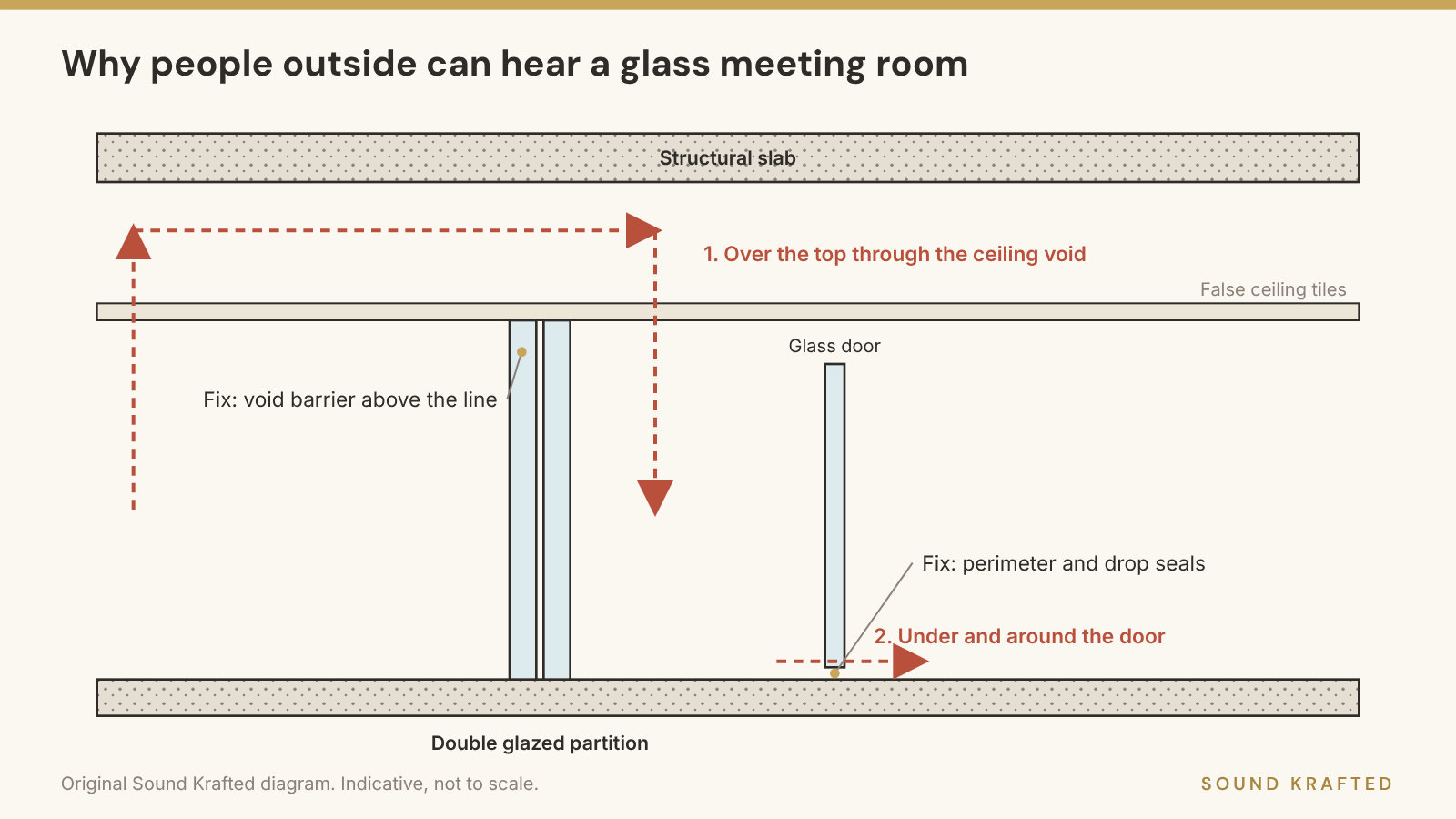
Why can people outside hear our meetings?
1. The glass door
A frameless glass door with open gaps can pull the whole partition down to about STC 25, whatever glass you use. Options that work:
- A framed glass door with compression seals on the jambs and head
- An automatic drop seal at the bottom, which closes the gap when the door shuts
- A solid acoustic door with a vision panel where privacy matters most
- Sliding doors only with tested acoustic seals; standard sliders leak badly
Where a solid door is the better answer, our guide to soundproof door cost factors explains the options.
2. The ceiling void
Many glass partitions stop at the false ceiling. Sound goes up through the light ceiling tiles, across the void and down into the next room or the open office. Fixes include extending the partition to the slab, or fitting a ceiling-void barrier of mineral wool and board above the partition line.
3. Glazing frames, mullions and joints
The glazing frame must be sealed to the slab, floor and walls with acoustic sealant, and gaps at a curtain wall mullion or column closed with a proper closer. Butt-jointed glass needs a continuous silicone or gasket joint; missing gaskets or open joints let sound through.
4. Shared ducts
Shared ducts also carry speech between glass rooms; see soundproofing HVAC ducts and air vents. For gypsum or brick partitions, see our partition wall planning guide.
Upgrading existing glass cabins
You do not always need to replace the glass. A typical upgrade sequence, from best value to biggest change:
- Seal the door: perimeter seals and an automatic drop seal.
- Close the ceiling void above the partition.
- Seal the head, base and wall junctions.
- Add absorption inside the room to lower the voice levels people use.
- Replace single toughened panes with laminated acoustic glass.
- For the most sensitive rooms, add a second glazing line to create a double partition.
Often the first three steps give most of the improvement, at a fraction of the cost of new glass.
Planning new glass partitions
- Decide the privacy level for each room before choosing the system.
- Ask the partition supplier for a tested rating of the complete system, including the door.
- Run the partition to the slab, or specify a matching void barrier.
- Use laminated acoustic glass or double glazing for meeting rooms.
- Coordinate with the AC contractor so ducts do not cross the partition unprotected.
- Add a manifestation strip for safety; it does not affect acoustics.
What shapes the cost
We give cost factors rather than prices: the length and height of the partition, glass type and thickness, single or double glazing, the door type and seals, frame finish, ceiling-void work, working hours in an occupied office, and the number of rooms. A survey and BOQ show which upgrades give the best result for your budget.
Our related work
Our meeting room soundproofing service covers glass-fronted rooms, door upgrades and ceiling voids. For outside-facing windows rather than internal partitions, see our comparison of acoustic glazing and double glazing. Our office and conference work includes the conference room with acoustic treatment for the International Water Management Institute in Lahore and acoustic consultancy for ENGRO in Sindh.
Glass partitions are one part of a quiet office. See office acoustic solutions for the full approach, and acoustic ceilings to control echo in glass-walled rooms.
Frequently asked questions
Can a glass partition be soundproof?
Yes, to a useful level. Laminated acoustic glass or double glazing in a sealed frame, with a sealed door and no ceiling-void leak, can give good speech privacy.
Why can people hear us through our new glass cabin?
Usually because of the door gaps or the ceiling void above the partition, not the glass. Seals and a void barrier often fix most of the problem.
Is double glazing better than laminated glass for partitions?
A double partition with a wide gap usually performs best. Single laminated acoustic glass is a good upgrade where space is tight.
Do glass doors need special seals?
Yes. Use compression seals on the frame and an automatic drop seal at the bottom. Frameless doors with open gaps leak a lot of sound.
Will soundproofing change the look of the cabin?
Not much. Laminated glass looks the same as toughened glass, seals are discreet, and void barriers are hidden above the ceiling.
Get your meeting rooms private
Send us a floor plan and photos of the cabins. Our team will survey the partitions, doors and ceiling, and recommend upgrades in order of value. Request a site survey and BOQ, or call or WhatsApp +92 300 8467101.
About the author: Sound Krafted Acoustics Team. Sound Krafted designs and builds soundproofing and acoustic treatment for government departments, universities, broadcasters and companies across Pakistan. Working since 2021, with 50 projects for 49 organisations. Main Jinnah Park, Harbanspura, Lahore 54850. Mon to Sat, 9 AM to 5 PM. info@soundkrafted.com, +92 300 8467101.