
The short answer: home theatre soundproofing and treatment are two jobs. Soundproofing keeps bass in and outside noise out, using heavy decoupled walls, an isolated ceiling, a sealed acoustic door and quiet air-conditioning. Acoustic treatment then makes dialogue clear and bass even, using absorption, bass traps and diffusion. Foam on the walls does neither job properly.
Home cinemas are now common in new houses and farmhouses around Lahore, Islamabad, Karachi and Faisalabad. Most owners spend heavily on the projector, screen and speakers, then find the bass shakes the bedrooms upstairs and the generator hum spoils quiet scenes. This guide explains how to plan the room so the equipment can do its job.
Why is a home theatre hard to soundproof?
- Low-frequency bass. Subwoofers produce long wavelengths that pass through single brick walls, lightweight gypsum and doors far more easily than speech does. Stopping bass needs mass and decoupling.
- The house shares one structure. RCC slabs, beams and columns carry vibration to every room. A cinema above a bedroom or next to a guest room needs extra care.
- Openings. Doors, windows, AC ducts, cable routes and light fittings are where most sound escapes.
- Quiet scenes. Background noise from split units, fans, traffic or a generator becomes obvious when the film is quiet.
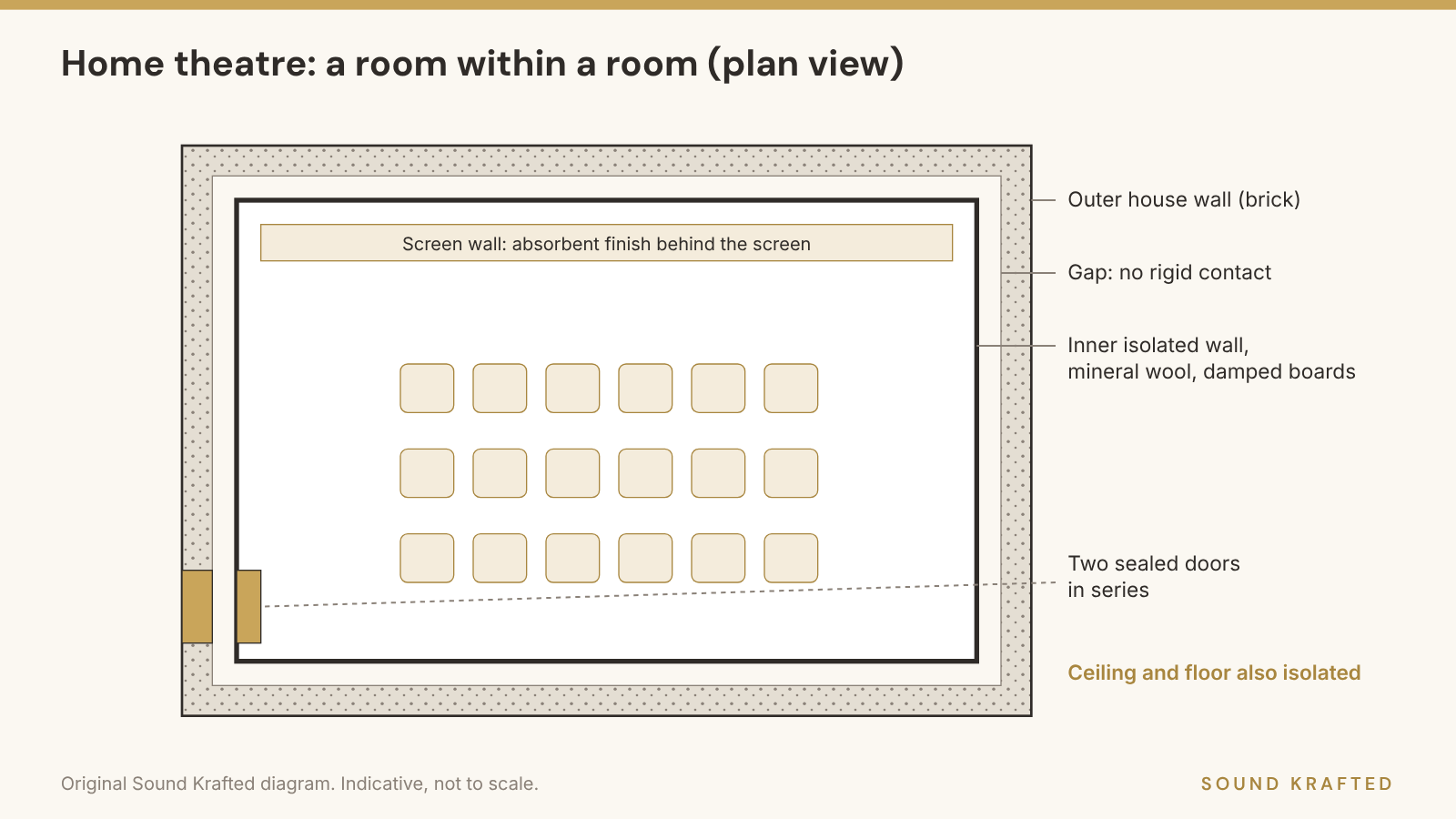
How do you keep sound in and noise out?
The most reliable method is a room within a room: new walls, ceiling and sometimes floor built on resilient fixings inside the existing room, so they never touch the house structure rigidly. Our article on room-within-a-room construction shows the principle in detail.
| Element | Typical isolation approach | Typical target |
|---|---|---|
| Walls | Independent stud lining in front of brick, mineral wool, two damped boards | STC 60 or more for bass-heavy use |
| Ceiling | Decoupled ceiling on isolation clips and channel, damped double board | STC 60 or more; better if a bedroom is above |
| Floor | Floating floor if the cinema sits above a living space | Improves impact and bass isolation |
| Door | Solid acoustic door with perimeter seals and drop seal, or two doors in series | STC 45 to 50 for a single door set; two doors in series to approach the STC 60 wall |
| Windows | Remove, block with a heavy plug, or fit acoustic glazing | Match the wall as closely as possible |
| AC | Lined ducts, slow air, units positioned away from seats | Background noise NC 25 or lower; NC 20 for a premium room |
Ratings are typical design targets used for home cinemas. STC (Sound Transmission Class) measures airborne sound insulation; see the general STC explainer for background. Ratings measured in a finished building are usually about 5 points below the laboratory figure, and can be 10 or more below where flanking paths are not controlled. We design with a margin. STC does not describe bass well. For a cinema, ask for the 63 and 125 Hz performance or Rw + Ctr of the wall and ceiling system. If the cinema sits below another room, our guide on footstep noise from upstairs explains the floor and ceiling choices.
The door decides the result
A standard hollow wooden door with a gap under it is the weakest point in almost every home theatre. Replace it with a solid acoustic door, fitted with compression seals around the frame and an automatic drop seal at the bottom. For very loud rooms, a small lobby with two doors works best. Our guide to soundproof door cost factors explains what shapes a door quotation. See our range of soundproof doors and acoustic windows.
Keeping the air-conditioning quiet
In Pakistan’s climate the AC runs during almost every film. A split unit on the wall above the screen is common, but it is noisy and its pipe holes leak sound. Better options include a ducted unit with lined ducts and large, slow diffusers, or a split unit placed at the rear with sealed penetrations. Keep the outdoor unit and any generator away from the cinema wall.
How should a home theatre be treated inside?
Once the room is sealed, treatment shapes what you hear:
- First reflections. Absorbent panels on the side walls and ceiling between the speakers and the seats keep dialogue clear.
- Bass control. Thick panels or bass traps in corners reduce booming and uneven bass across seats.
- Rear wall. Absorption or diffusion stops late echoes returning to the listener.
- Screen wall. An absorbent finish behind an acoustically transparent screen hides speakers and stops reflections.
- Soft finishes. Carpet, heavy curtains and upholstered seating add helpful absorption, but are not enough on their own.
For the difference between foam and fabric panels, read acoustic foam vs acoustic panels. Aim for a fairly short, even reverberation time. A room that is too dead feels unnatural; a room that is too live blurs speech.
Room size and shape
Square rooms and rooms with one dimension double another give uneven bass. A rectangular room with different length, width and height ratios performs better. If you are building new, talk to the architect early: it is much easier to plan wall thickness, ceiling height and duct routes before the brickwork starts. In an existing house, the survey checks the slab, walls and windows so the design works with the building.
Planning checklist for a house
- Choose a room away from bedrooms, or plan extra isolation where one is unavoidable.
- Allow for lost space: an isolated lining takes roughly 75 to 125 mm per wall, more for double frames.
- Plan the door, AC, electrical and data routes before closing the walls.
- Decide speaker positions before treatment, so panels and traps go in the right places.
- Choose seating and carpet as part of the acoustic design.
- Keep projector and equipment rack noise out of the room, or in a ventilated cabinet.
What shapes the cost
We do not publish fixed prices because every house differs. The main cost factors are the room size, how much isolation is needed (a basement cinema needs less than one above a bedroom), the wall and ceiling build-ups, the door and window solution, the AC changes, the treatment finishes and any interior work such as seating, carpet and lighting.
How Sound Krafted helps
We design and install isolation and treatment for commercial cinemas, screening rooms and home theatres, and we coordinate with the sound system and seating. Our cinema hall soundproofing page explains the same principles at larger scale. Related hall work on our client list includes the turnkey auditorium for the Punjab Education Foundation and the auditorium acoustic treatment at Mukabbir University of Science and Technology, Lahore.
For the door into a home cinema, see soundproof doors; for studio-grade rooms, see recording studio soundproofing.
Frequently asked questions
Can I soundproof a home theatre in an existing house?
Yes. We usually build a room within a room on resilient fixings, fit a sealed acoustic door and treat the interior. The survey checks the slab, walls and windows first.
Is acoustic foam enough for a home cinema?
No. Foam can tidy up high-frequency reflections, but it does not stop sound escaping and does little for bass.
How much space will soundproofing take?
An independent wall lining usually takes about 75 to 125 mm per wall, and a decoupled ceiling takes some height. We confirm the exact figure in the design.
Will the bass still be heard upstairs?
Some bass may still be felt in very quiet rooms, but a decoupled ceiling, a floating floor where needed and a sealed door reduce it a great deal. Placing the cinema away from bedrooms helps most.
Do you also supply seating and carpet?
Yes. We supply seating, carpet and finishes as part of the room design, so one team coordinates everything.
Plan your home theatre
Send us the room size, the floor it is on and what is above and beside it. Our team will visit, explain the options and prepare a design and BOQ; see how we build a room within a room. Request a consultation or quote, or call or WhatsApp +92 300 8467101.
About the author: Sound Krafted Acoustics Team. Sound Krafted designs and builds soundproofing and acoustic treatment for government departments, universities, broadcasters and companies across Pakistan. Working since 2021, with 50 projects for 49 organisations. Main Jinnah Park, Harbanspura, Lahore 54850. Mon to Sat, 9 AM to 5 PM. info@soundkrafted.com, +92 300 8467101.