
Unwanted noise can affect homes, offices, studios, and other spaces. Traffic, construction, machinery, conversations, neighboring rooms, and outdoor activities can make a space uncomfortable, distracting, or difficult to use. This is why professional soundproofing services in Pakistan are becoming increasingly important for residential, commercial, educational, industrial, and entertainment spaces.
Soundproofing is not simply about making a room completely silent. It is about reducing unwanted sound and improving the way sound behaves within a space. Depending on the needs of the project, this may include wall insulation, acoustic panels, soundproof doors, ceiling treatments, flooring systems, vibration control, and other specialized materials.
At SoundKrafted, soundproofing and acoustic solutions are designed according to the needs of each space. The company provides customized solutions for homes, offices, recording studios, cinemas, educational facilities, industrial environments, and other commercial spaces.

What Is Soundproofing?
Soundproofing is the process of reducing the amount of sound travelling from one area to another. The goal is to prevent unwanted noise from entering a room or escaping from it. For example, a recording studio needs protection from traffic, conversations, machinery, and other outside sounds. At the same time, music and vocals produced inside the studio should not disturb people outside. Similarly, an office meeting room may need sound isolation to improve privacy and prevent conversations from travelling into nearby rooms.
Effective soundproofing usually requires more than adding one material to a wall. Sound can travel through walls, doors, windows, ceilings, floors, ventilation systems, and structural connections. A good soundproofing solution should therefore consider the entire room and identify the main paths through which sound is travelling.
This is why professional assessment and customized design are important when choosing soundproofing solutions in Pakistan.

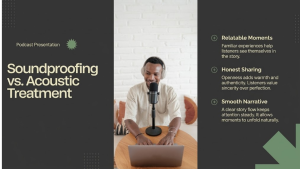
Soundproofing VS Acoustic Treatment: What Is The Difference?
One common misunderstanding is that soundproofing and acoustic treatment are the same thing. While both are related to sound control, they serve different purposes.
Soundproofing focuses on reducing the amount of sound travelling between spaces. It may involve adding mass, sealing gaps, isolating structures, and using suitable insulation systems.
Acoustic treatment, on the other hand, focuses on controlling sound reflections within a room. Acoustic panels, absorbers, bass traps, and diffusers can help reduce excessive reverberation and improve sound clarity.
For example, a recording studio may need soundproofing to reduce external noise while also using acoustic treatment to control reflections inside the recording space.
At SoundKrafted, both sound isolation and acoustic treatment solutions are available to meet the specific requirements of different spaces. The company also offers acoustic panels and materials solutions to help absorb unwanted reflections, improve speech clarity, and create a more balanced acoustic environment.
Why Professional Soundproofing Matters In Pakistan?
Noise is a growing concern in busy urban and commercial environments. Traffic, construction, commercial activity, generators, industrial machinery, and densely populated neighborhoods can all contribute to unwanted sound. Constant exposure to noise can affect comfort, concentration, privacy, and the overall usability of a space.
The World Health Organization recognizes environmental noise as an important public-health concern and reports that excessive noise can interfere with sleep, daily activities, performance, and overall well-being.
Professional noise control solutions can help reduce these problems by addressing the main sources and paths through which sound travels. The right approach depends on the type of property, the source of the noise, and the level of sound control required.
1. Better Comfort at Home
Constant external noise can make it difficult to relax, sleep, study, or work from home. Traffic, nearby construction, loud neighbors, and other everyday sounds can enter through walls, doors, ceilings, windows, and other weak points.
Home soundproofing can help reduce unwanted noise and create a more comfortable environment for everyday living. It can be particularly useful in bedrooms, living spaces, home offices, and other areas where quiet and privacy are important.
2. Improved Office Productivity
Open offices and busy workplaces can contain conversations, equipment sounds, phone calls, HVAC noise, and other distractions. Excessive background noise can make it harder for employees to concentrate and communicate effectively.
A well-planned office acoustic solution can help control unwanted noise, reduce echo, and improve speech clarity. Soundproof meeting rooms can also provide greater privacy for confidential discussions, meetings, and video conferences.
3. Better Recording Quality
Recording studios require carefully controlled acoustic environments. Even high-quality microphones and professional audio equipment cannot fully compensate for severe background noise, unwanted reflections, or excessive reverberation.
Professional recording studio soundproofing can help reduce external noise and prevent sound from travelling between rooms. At the same time, acoustic treatment can improve the way sound behaves inside the recording space, which is important for vocals, music, podcasts, voiceovers, and other audio production.
For professional projects, SoundKrafted offers soundproofing and acoustic solutions that can be tailored to the requirements of different spaces, including homes, offices, and recording studios.

Key Soundproofing Solutions For Different Spaces
Every building has different construction characteristics and noise challenges. A residential bedroom may need a different solution from an industrial facility or professional recording studio. The right approach depends on the type of space, the source of the noise, and how sound travels through the building.
Soundproofing For Homes
Homeowners commonly experience noise from traffic, neighbors, construction, appliances, and nearby commercial activity.
A customized residential soundproofing system may include:
- Acoustic insulation
- Door seals
- Wall treatments
- Soundproof windows
- Acoustic panels
- Ceiling treatments
- Flooring solutions
- Heavy curtains and other complementary treatments
The right combination depends on where the noise originates and how it reaches the room.
For homeowners searching for soundproofing services in Lahore or other cities in Pakistan, a professional assessment can help identify the areas that need the most attention.
Recording Studio Soundproofing
A professional recording environment requires both sound isolation and acoustic control.
Studio soundproofing may involve:
- Sound-isolated walls
- Acoustic doors
- Sealed windows
- Ceiling isolation
- Floating or isolated floors
- Acoustic panels
- Bass traps
- Vibration control
- Specialized insulation materials
Professional studios need to address both external noise sources and internal acoustic reflections. This makes acoustic planning especially important for music studios, podcast rooms, broadcast facilities, voiceover rooms, and content production spaces.
Office And Meeting Room Soundproofing
Confidential conversations should remain within the intended room. However, thin partitions, doors, glass surfaces, and open layouts can allow voices to travel between areas.
Professional meeting-room soundproofing can help address:
- Echo
- Noise leakage
- Background distractions
- Speech intelligibility
- Privacy concerns
- Video conferencing issues
SoundKrafted’s meeting room soundproofing service focuses on boardrooms, conference rooms, training rooms, video meeting spaces, and corporate offices.

Home Theater And Cinema Soundproofing
A home theater should provide an immersive audio experience without allowing excessive sound to disturb the rest of the property. Home theater soundproofing can combine wall insulation, acoustic panels, soundproof flooring, doors, and other treatments to reduce sound leakage while improving internal audio performance.
Home theater solutions should be selected according to the room structure, audio requirements, and level of sound isolation needed.
Industrial Noise Control
Industrial environments can contain machinery, production equipment, compressors, generators, and other sources of high-level noise. Industrial acoustic systems may use barriers, enclosures, insulation, vibration control, and specialized sound-absorbing materials. The objective is not simply to make the facility quieter. Effective industrial noise control can also improve communication, comfort, and the overall working environment.

SoundKrafted also provides industrial noise control solutions for commercial and industrial facilities, with the approach tailored to the specific noise source and environment.
The Role Of Acoustic Panels In Noise Control
Acoustic panels are among the most commonly used components in modern acoustic treatment. Their primary purpose is to absorb unwanted sound energy and reduce reflections within a room. This can help control echo and improve speech and audio clarity.
However, acoustic panels should not be considered a complete soundproofing system. Panels mainly address sound within a room, while effective sound isolation requires consideration of walls, ceilings, floors, doors, windows, gaps, and structural transmission. For this reason, choosing the right material and placing it in the appropriate locations is important for achieving the desired acoustic results.
SoundKrafted provides professional acoustic panels and materials for offices, meeting rooms, recording studios, and other environments requiring improved sound control.
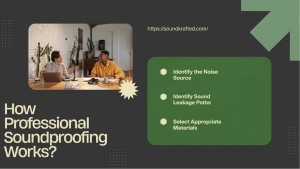
How Professional Soundproofing Works
A successful soundproofing project normally begins with an assessment of the space and the specific noise problem.
Step 1: Identify the Noise Source
The first step is determining where unwanted sound comes from. It may originate outside the building, from another room, from machinery, from above, or from building services such as HVAC systems.
Step 2: Identify Sound Leakage Paths
After identifying the source, professionals examine the routes through which sound travels. Small gaps around doors, windows, ducts, and other openings can reduce the effectiveness of an otherwise strong soundproofing system.
Step 3: Select Appropriate Materials
Different frequencies and noise sources require different approaches. A professional acoustic design may combine mass, absorption, isolation, sealing, and vibration-control techniques.
Step 4: Install the System Correctly
Even high-quality materials cannot perform effectively if they are installed incorrectly. Proper detailing, sealing, spacing, and structural installation are essential.
Step 5: Evaluate the Result
The completed environment should be assessed against the original requirements. Professional acoustic engineering can use measurements and appropriate performance criteria to evaluate sound insulation.
International standards such as ISO 717-1 provide methods for rating airborne sound insulation in building elements such as walls, floors, doors, and windows.
Why Customized Acoustic Solutions Are Better?
There is no universal soundproofing product that works equally well for every room.
Consider two different properties. One may have traffic noise entering through windows, while another may have loud equipment transmitting vibration through the structure. Using the same material in both spaces would not necessarily provide the same result.
A customized approach considers:
- Room dimensions
- Building construction
- Noise source
- Noise frequency
- Existing insulation
- Doors and windows
- Ceiling and floor construction
- Intended use of the room
- Required level of privacy or isolation
- Budget and installation requirements
SoundKrafted emphasizes customized soundproofing and acoustic systems for studios, offices, homes, and commercial spaces rather than applying the same solution to every project.
Common Mistakes When Soundproofing A Room
Many people attempt DIY soundproofing without first understanding how sound travels. This can lead to unnecessary expenses and disappointing results.
Using Only Acoustic Foam
Acoustic foam can help control sound reflections inside a room, but it is not a complete solution for reducing sound transmission between spaces.
Ignoring Doors and Windows
A heavily treated wall will not solve the problem if significant sound can still pass through a poorly sealed door or window. These areas should be considered as part of the overall soundproofing system.
Treating Only One Surface
Sound can travel through multiple structural paths. Treating one wall while ignoring the ceiling, floor, or adjacent structures may limit the overall effectiveness of the solution.
Choosing Materials Without an Assessment
The most suitable material depends on the type and source of the noise. A professional assessment can help prevent money from being spent on products that do not address the actual problem.
How To Choose The Right Soundproofing Company In Pakistan
When searching for soundproofing companies in Pakistan, customers should consider more than price. A suitable company should have the technical knowledge, experience, and installation capability required for the specific project.
Look for a company that offers:
- Experience: Acoustic projects require an understanding of sound transmission, building structures, and different noise-control methods.
- Customized solutions: Every property has different acoustic challenges, so the solution should be based on the space and noise problem.
- Quality materials: Professional-grade materials should be selected according to the requirements of the project.
- Proper installation: Installation quality can have a major impact on the final acoustic performance.
- Multiple applications: Experience with studios, offices, homes, cinemas, and industrial environments can indicate the ability to handle different acoustic requirements.
- Consultation: A professional assessment should ideally be completed before recommending a final system.
SoundKrafted offers soundproofing and acoustic solutions for a range of applications, including studios, corporate offices, industrial facilities, homes, meeting rooms, cinemas, and educational spaces.
Why Choose SoundKrafted For Acoustic Solutions?
SoundKrafted focuses on professional soundproofing and acoustic solutions designed around the requirements of different spaces. Its services cover a range of applications, including recording studios, meeting rooms, offices, cinemas and home theaters, educational spaces, industrial environments, and acoustic panels and materials.
A key part of the approach is customization. Acoustic requirements can vary significantly depending on the building structure, noise source, room layout, and intended use of the space.
If you are developing a recording studio, upgrading an office, creating a home theater, improving privacy in a meeting room, or addressing industrial noise, the right solution should begin with understanding the specific acoustic problem.
Final Thoughts
Noise control is not limited to professional recording studios. Homes, offices, educational facilities, cinemas, hotels, commercial buildings, and industrial environments can all benefit from properly designed acoustic solutions.
The most effective approach is not simply to purchase a few sound-absorbing materials. Professional soundproofing services in Pakistan should begin with identifying the noise source, understanding how sound travels through the building, selecting suitable materials, and installing them correctly.
From home soundproofing and office acoustic solutions to recording studio isolation and industrial noise control, the right solution depends on the requirements of each space.
If you are dealing with unwanted noise, echo, poor speech clarity, sound leakage, or an uncontrolled recording environment, a professional acoustic assessment can help determine the most suitable solution.
For consultation or a customized project quotation, visit the SoundKrafted contact page or explore the company’s soundproofing and acoustic solutions.
Frequently Asked Questions
1. What is the difference between soundproofing and acoustic treatment?
Soundproofing reduces sound transmission between spaces, while acoustic treatment controls reflections and reverberation within a room.
2. Can soundproofing completely eliminate noise?
Not always. The level of noise reduction depends on the building, noise source, frequency, and soundproofing system.
3. Are acoustic panels enough to soundproof a room?
Usually not. Acoustic panels control reflections, while sound isolation may require walls, doors, ceilings, floors, insulation, and sealing.
4. Is professional soundproofing suitable for homes?
Yes. It can be designed for bedrooms, living rooms, home offices, apartments, and home theaters based on the noise problem.
5. How much does soundproofing cost in Pakistan?
Costs vary depending on room size, materials, construction, noise level, and installation requirements. A professional assessment can provide a more accurate estimate.
6. Can offices benefit from acoustic treatment?
Yes. Acoustic treatment can reduce distractions, improve speech clarity, and support privacy in the workplace.
7. Does a recording studio need both soundproofing and acoustic treatment?
Yes, in most professional applications. Soundproofing controls sound transmission, while acoustic treatment controls reflections inside the studio.
8. How do I get a soundproofing consultation in Pakistan?
Contact SoundKrafted to discuss your space and noise problem and find a suitable acoustic solution.
Suggested External References
For readers who want to understand the technical and health aspects of noise control, the [World Health Organization’s environmental noise guidance] provides evidence-based information about noise and health.
For technical information about airborne sound insulation in buildings, [ISO 717-1:2020] provides an international framework for rating sound insulation in building elements.
For building-acoustics calculations concerning airborne sound insulation between rooms, [ISO 12354-1:2017] provides relevant calculation models and technical guidance.