
Distorted sound damages communication faster than silence. A weak sound system disrupts meetings, confuses announcements, and lowers the quality of professional events. In industrial environments, unclear audio can even create safety risks. Businesses in Lahore, Karachi, and Islamabad now demand structured and reliable audio performance because sound clarity directly affects operations, safety, and brand reputation.
A commercial sound system does more than amplify voices. It distributes sound evenly across space, controls distortion, and prevents feedback. Every word must reach the audience clearly, whether inside a boardroom, factory floor, training hall, auditorium, or institutional facility. Modern organizations treat audio infrastructure as operational equipment rather than decoration. When installed correctly, a professional sound system improves productivity, coordination, and credibility.
This guide explains how a commercial sound system works, why it matters for businesses, and how to choose the right configuration for professional environments.
What Is a Professional Sound System?
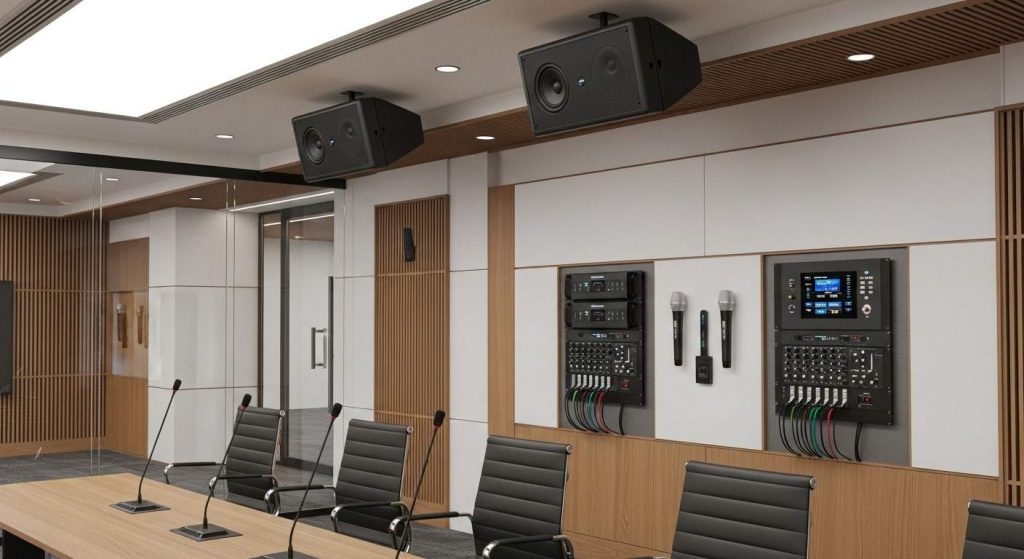
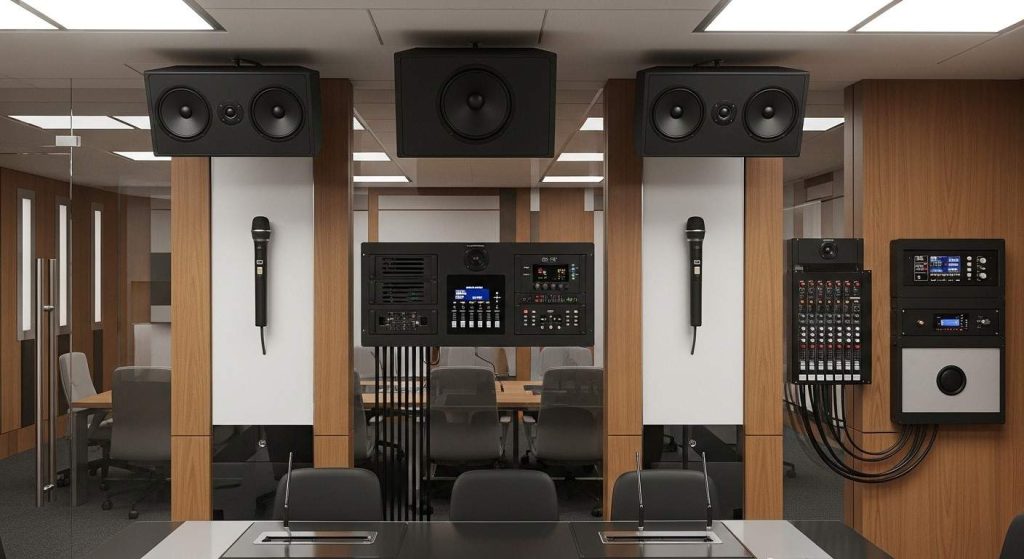
A professional sound system is an integrated audio setup designed for controlled sound distribution in commercial spaces. It combines speakers, amplifiers, mixers, digital processors, and wireless microphones into one coordinated structure. Each component performs a defined role. Speakers project sound across the room. Amplifiers deliver controlled power to maintain clarity. Mixers manage multiple input sources such as podium microphones, laptops, and presentation systems. Digital signal processors refine tone, balance frequencies, and minimize distortion.
Unlike consumer audio devices, commercial systems focus on coverage and speech intelligibility. They distribute audio evenly across large environments without creating uneven volume zones. Many organizations confuse a public address system with a complete sound system. A public address system mainly handles announcements and alerts. A full sound system supports conferences, training sessions, presentations, and live events with greater flexibility and control.
Speech clarity remains the core objective. International telecommunications standards emphasize the importance of intelligibility in public communication environments. High volume alone does not ensure understanding. Balanced frequency response and calibrated amplification create clear, fatigue-free listening conditions.
Why Businesses in Lahore, Karachi, and Islamabad Need a Reliable Sound System
Clear communication drives performance. Poor audio weakens coordination and reduces attention. Corporate offices in Lahore host daily meetings and training programs. Karachi’s industrial facilities depend on clear announcements for operational safety. Islamabad’s institutions organize conferences and educational sessions that require precise sound delivery.
Without a structured sound system, echo develops quickly in large halls and open-plan offices. Reflective materials such as concrete, glass, and marble scatter sound unevenly. Voices overlap and become unclear. Workplace safety guidelines highlight the importance of effective communication in environments with background noise. Clear audio reduces misunderstandings and improves response time.
Modern systems solve these issues through calculated speaker placement, controlled amplification, and stable wireless microphone integration. In Karachi’s event venues, reliable wireless microphones allow presenters to move without signal interruption. In Lahore’s corporate centers, calibrated systems ensure that every participant hears clearly and in Islamabad’s institutional environments, controlled sound reinforces professional standards.
Core Components of a Commercial Sound System
Every professional sound system relies on coordinated components working together. Speakers determine coverage patterns and projection accuracy. Poor placement creates dead zones or excessive volume in certain areas. Amplifiers must match speaker specifications precisely. Incorrect matching leads to distortion or inefficient performance.
Mixers allow operators to manage multiple audio inputs simultaneously, ensuring that speech and multimedia content blend smoothly. Digital signal processors refine the audio signal further by reducing feedback, stabilizing output, and balancing frequency ranges. Proper configuration prevents harsh sound and maintains natural voice clarity.
Wireless mic systems add flexibility to professional environments. Trainers, speakers, and event hosts move freely without cable restrictions. Reliable wireless microphones operate on stable frequency bands that minimize interference in dense commercial areas such as Karachi and Lahore.
Understanding Public Address System Integration
A public address system usually operates as part of a larger, fully integrated sound system setup. It ensures clear announcements across office complexes, industrial plants, and institutional campuses. While a public address system focuses on broadcasting messages, the complete sound system manages broader audio needs such as conferences and multimedia presentations.
Industrial facilities rely on integrated systems for safety alerts and coordination. Corporate environments use them for structured communication across departments. Integration ensures consistent performance across multiple zones within a building.
Proper signal routing prevents distortion and feedback. Professional calibration ensures balanced output across every connected area.
Wireless Microphones and Professional Audio Flexibility
Mobility improves engagement in professional settings. Wireless microphones allow presenters to move naturally while maintaining consistent sound quality. Modern systems operate on stable UHF frequencies to reduce interference in crowded environments.
Signal stability matters more than range alone. Low-quality systems often create dropouts and static noise. Professional-grade wireless mic setups maintain clarity even when multiple devices operate simultaneously.
Conference centers in Islamabad frequently depend on wireless microphones for panel discussions and training programs. Event venues in Karachi rely on stable transmission for large gatherings. Corporate facilities in Lahore integrate wireless mic systems to enhance meeting effectiveness.
A properly configured sound system ensures seamless integration between wireless microphones, mixers, and amplifiers.
How to Design a Sound System for Commercial Spaces
Design begins with understanding purpose and environment. A conference room requires balanced speech projection. An auditorium demands wide coverage and consistent output. An industrial facility needs controlled amplification that overcomes ambient noise without exceeding safe decibel levels.
Room dimensions, ceiling height, and surface materials influence system configuration. Sound pressure level must align with audience size. Excessive power creates discomfort. Insufficient power reduces clarity.
Engineers calculate coverage angles to prevent dead zones and feedback. Reflective interiors common in commercial buildings across Lahore and Karachi require careful calibration to maintain balanced acoustics.
Zoned Audio Distribution for Large Commercial Facilities
Large facilities require controlled zoning. A single uniform output rarely works in commercial environments. Office complexes in Islamabad, industrial plants in Karachi, and multi-level event venues in Lahore demand segmented audio distribution.
Zoned design allows different areas to operate independently. Conference rooms may require presentation mode while common areas run announcement mode. Industrial sections may require higher output for safety alerts without affecting administrative offices.
Centralized control systems manage these zones efficiently. Operators adjust volume, routing, and scheduling from a single interface. This flexibility improves operational coordination.
Zoned architecture also supports emergency communication protocols. Clear alerts must reach targeted areas without delay. Integrated public address system functionality ensures rapid distribution when required.
Structured zoning enhances scalability. As facilities expand, additional zones integrate into the existing sound system without major reconstruction.
Common Mistakes Businesses Make
Many organizations prioritize low cost over performance. They select underpowered equipment or ignore acoustic considerations. Cheap wireless microphones cause signal instability during critical events. Skipping professional calibration results in uneven sound distribution.
Another frequent mistake involves ignoring future scalability. Commercial environments evolve. Meeting spaces expand. Event venues grow in capacity. A scalable sound system protects long-term investment.
Technical Standards and Performance Considerations
Performance measurement defines quality. Sound pressure level indicates output strength. Frequency response determines clarity across low, mid, and high ranges. Balanced audio ensures speech intelligibility without harshness.
Workplace safety standards outline safe exposure limits to protect hearing. Proper calibration maintains clarity while keeping output within acceptable decibel levels. Certified components meet electrical and safety standards. Businesses in Lahore, Karachi, and Islamabad should verify compliance documentation before installation.
Acoustic Environment and Its Impact on Sound System Performance
Even the most advanced sound system cannot perform properly in a poorly treated environment. Acoustic conditions directly influence clarity, projection, and listener comfort. Large commercial spaces in Lahore and Karachi often feature reflective materials such as glass walls, marble flooring, and exposed ceilings. These surfaces reflect sound waves unpredictably and increase reverberation.
Excessive reflection reduces speech intelligibility. Voices overlap and create fatigue. A structured approach considers both the sound system and the room’s acoustic behavior. Absorptive panels, ceiling treatments, and proper speaker angling improve performance significantly.
Engineers calculate reverberation time before final calibration. Balanced acoustics allow the system to operate at lower power while maintaining clarity. This reduces strain on equipment and protects long-term reliability.
A professional installation never treats the sound system as an isolated component. It integrates audio distribution with acoustic control to ensure consistent results.
Return on Investment and Long-Term Value
A professionally designed sound system represents a long-term operational asset. Clear communication reduces repetition in meetings and improves training efficiency. In industrial environments, precise announcements reduce operational delays.
Equipment durability also affects investment value. High-quality amplifiers, certified speakers, and reliable wireless microphones reduce replacement frequency. Proper calibration prevents strain and extends lifespan. Organizations in Lahore and Karachi that prioritize structured installation often experience lower maintenance costs over time. Scalable infrastructure allows upgrades without full system replacement.
Audio quality also influences brand perception. Clear sound during conferences and public events strengthens credibility. Poor audio leaves a lasting negative impression.Strategic planning at the beginning prevents costly corrections later. When businesses treat audio infrastructure as essential rather than optional, they secure measurable long-term benefits.
Professional audio infrastructure also supports hybrid meetings and digital broadcasting, ensuring consistent sound quality across in-person and virtual audiences. As businesses in Lahore, Karachi, and Islamabad expand their operations, a scalable sound system provides the flexibility required for future growth.
Frequently Asked Questions
Q: What is the difference between a public address system and a full sound system?
A: A public address system focuses on announcements. A full sound system supports presentations, events, and multimedia functions with advanced control.
Q: How powerful should a commercial sound system be?
A: Power depends on room size and audience capacity. Professional assessment ensures balanced amplification.
Q: Are wireless microphones reliable for corporate events?
A: High-quality wireless microphones provide stable transmission when configured correctly.
Q: What causes feedback in a sound system?
A: Feedback occurs when amplified sound re-enters a microphone. Proper placement and digital processing prevent it.
Q: Do commercial sound systems require maintenance?
A: Yes. Periodic calibration maintains performance and extends equipment life.
Q: How long does a professional sound system last?
A: With proper installation and maintenance, commercial systems operate efficiently for many years.
Q: Can a sound system improve workplace productivity?
A: Clear communication reduces confusion and repetition, improving overall efficiency.
Conclusion
Clear sound supports clear decisions. A properly engineered sound system strengthens communication across corporate offices, institutions, industrial facilities, and event venues. It ensures that every message reaches its audience with clarity and confidence.
Businesses in Lahore, Karachi, and Islamabad increasingly recognize that structured audio infrastructure enhances productivity, safety, and professional credibility. A well-calibrated sound system forms the foundation of professional communication and long-term operational excellence.