
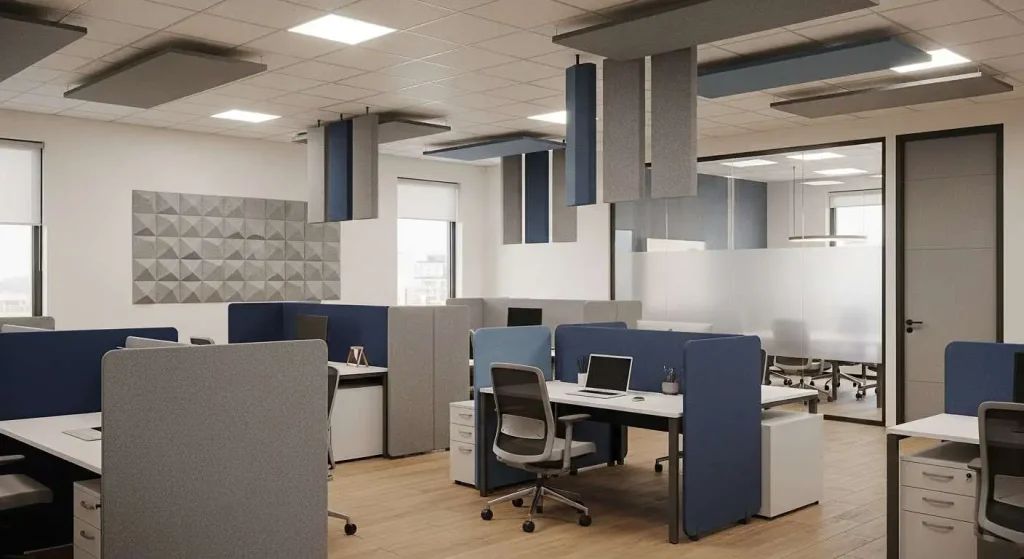
Modern workplaces look sleek and open. However, sound control often receives little attention during design. Glass partitions, open ceilings, and shared desks create visual transparency. Yet these same features amplify noise. As a result, conversations overlap, echo builds, and concentration drops. In fast-growing commercial hubs like Lahore, Karachi, and Islamabad, open plan offices dominate corporate construction. Therefore, structured office soundproofing has become a strategic necessity rather than an optional upgrade.
Noise inside a workplace affects focus, communication, and professional perception. Moreover, constant background distraction increases listening fatigue. When meetings occur in echo-heavy rooms, speech clarity declines. Consequently, employees repeat themselves, productivity slows, and clients notice the difference. A well-planned acoustic strategy restores control over internal sound behavior and supports performance-driven environments.
How Sound Behaves Inside Office Environments
Sound moves in wave patterns and bounces back when it hits solid surfaces. Glass, marble, polished tiles, and drywall reflect most frequencies. Therefore, reflections accumulate and extend reverberation time. The longer the sound lingers, the harder speech becomes to understand.
Reverberation time, often measured as RT60, indicates how long sound remains audible after the source stops. In meeting rooms and collaborative zones, excessive RT60 reduces clarity. As a result, speech intelligibility declines and mental fatigue increases. Proper acoustic control shortens reverberation and stabilizes communication.
However, reflection is not the only challenge. Sound also transfers through partitions, doors, and ceilings. This transmission affects privacy. Therefore, a complete office soundproofing plan must address both internal echo and structural leakage.
Core Components of an Effective Acoustic Strategy
A professional approach combines absorption and isolation. Absorption reduces reflection within a room. Isolation limits sound travel between spaces. When these two principles work together, workplace acoustics improve significantly.
Office soundproofing panels manage mid and high-frequency reflections. These panels use mineral wool, fiberglass insulation, or PET fiber cores. Porous materials trap sound waves and convert vibration into minimal heat energy. Consequently, reflected noise decreases.
Soundproof office booth systems create enclosed zones for calls and focused tasks. These booths use layered materials and acoustic seals to reduce transmission. Similarly, soundproof office pods provide private discussion areas within open layouts. Therefore, businesses maintain collaboration while protecting confidentiality.
Glass partitions require additional treatment. Soundproof glass office partitions often include laminated layers or double glazing. These solutions reduce airborne transmission. Meanwhile, acoustic seals around frames prevent flanking noise.
Managing Open Office Noise
Open-plan environments encourage teamwork. However, they amplify background sound. Keyboards, phone calls, and informal discussions merge into constant noise. Therefore, open office soundproofing must prioritize balanced absorption.
Wall-mounted absorption panels control reflection. Ceiling baffles reduce vertical echo. In addition, carpeted flooring lowers impact noise. When these elements combine, overall sound levels stabilize.
Zoning also improves performance. Quiet areas require stronger absorption coverage. Collaborative areas need controlled reverberation rather than complete dampening. Consequently, acoustic planning aligns with workspace function.
Moreover, thoughtful furniture placement influences reflection patterns. Soft seating and fabric partitions absorb part of the sound field. Although furniture alone cannot solve acoustic problems, it supports engineered treatment.
Doors, Furniture, and Structural Weak Points
Doors often allow sound leakage. Hollow-core doors transmit speech easily. Therefore, replacing them with solid-core doors improves isolation. Acoustic gaskets around frames prevent sound escape. Drop seals at the bottom reduce gaps that compromise privacy.
Office furniture can also affect acoustic performance. Large wooden surfaces reflect mid frequencies. Meanwhile, padded chairs absorb part of the energy. Consequently, material choice matters.
Soundproof office chairs or pods designed with internal absorption add additional benefit in call-intensive environments. However, these solutions should complement wall and ceiling treatment rather than replace it.
Measuring Acoustic Performance
Performance should rely on data, not assumption. The Noise Reduction Coefficient shows the amount of sound energy a material can absorb. An NRC of 0.80 means the material absorbs 80 percent of sound energy. Therefore, higher NRC values indicate stronger absorption.
Sound Transmission Class measures how well a partition blocks sound. Higher STC ratings reduce speech transfer between rooms. In conference facilities and executive offices, strong STC performance ensures privacy.
International standards such as ASTM E90 and ISO 354 guide testing methods. These standards provide reliable measurement benchmarks. Consequently, businesses should request certified data before installation.
Without measurement, acoustic treatment becomes guesswork. However, when engineers calculate reverberation and transmission levels first, results become predictable and controlled.
Glass Partitions and Meeting Room Challenges
Glass-heavy boardrooms present unique challenges. Hard reflective surfaces create a flutter echo between parallel walls. Therefore, untreated meeting rooms often sound sharp and harsh.
Acoustic wall treatment behind glass partitions improves balance. Alternatively, applying laminated acoustic glass reduces reflection and transmission simultaneously. As a result, meetings sound clearer and more professional.
Ceiling treatment also plays a critical role. When ceilings remain untreated, sound reflects downward repeatedly. Therefore, combining ceiling absorption with wall panels enhances overall clarity.
In executive meeting spaces in Karachi’s commercial towers, balanced acoustic planning improves presentation quality. In Lahore’s corporate offices, improved speech clarity supports better negotiation outcomes. Similarly, government facilities in Islamabad benefit from controlled reverberation during formal sessions.
Materials Used in Professional Applications
Mineral wool remains one of the most reliable absorption materials. Its dense fibrous structure traps sound waves efficiently. Fiberglass insulation offers similar performance with lightweight structure. Both materials maintain stable absorption over time.
Mass-loaded vinyl adds isolation by increasing barrier mass. Therefore, it reduces sound transfer through partitions. Double-layer drywall with damping compounds also strengthens isolation performance.
Acoustic foam panels work well for high-frequency control. However, foam alone cannot block sound transmission. Therefore, professional planning must combine absorption and structural reinforcement.
Door seals, acoustic gaskets, and threshold drops prevent flanking leakage. Small gaps often weaken isolation more than wall structure itself. Consequently, sealing details matter significantly.
Cost Considerations and Long-Term Value
Initial investment varies depending on coverage and materials. However, improved productivity offsets installation costs over time. When employees focus better, output increases. Consequently, acoustic control supports operational efficiency.
Professional office soundproofing reduces meeting repetition and communication errors. In addition, client-facing spaces feel more refined. Therefore, acoustic improvement strengthens brand perception.
Maintenance requirements remain minimal. Most absorption panels require occasional cleaning only. Structural isolation solutions maintain performance for years without replacement.
Common Acoustic Planning Mistakes
Over-absorbing a space creates a dull atmosphere. Under-treatment leaves echo unresolved. Therefore, balanced coverage remains essential.
Ignoring ceiling surfaces reduces effectiveness. Sound reflects from all directions, not just walls. Consequently, multi-surface coordination ensures optimal results.
Relying solely on decorative foam products often fails. Without structural isolation, speech privacy remains compromised. Therefore, planning must consider both reflection and transmission.
Skipping professional assessment leads to inconsistent outcomes. Measurement-based planning ensures reliable improvement.
The Role of Acoustic Planning in Corporate Productivity
A workplace does not fail because of design alone. It fails when performance barriers go unnoticed. One of the biggest hidden barriers in commercial spaces is uncontrolled sound. Although many companies invest in aesthetics, they often overlook acoustic balance. As a result, noise gradually affects focus, accuracy, and team morale.
In fast-growing commercial districts of Lahore and Karachi, modern offices feature glass façades and open ceilings. While these elements look impressive, they reflect and circulate sound across the entire floor. Consequently, even small conversations travel further than intended. Over time, this increases cognitive load and reduces efficiency.
Strategic office soundproofing supports structured workflow. When sound reflections are reduced, meetings become clearer. When transmission between rooms decreases, privacy improves. Therefore, employees feel more confident during calls and presentations.
Moreover, controlled acoustics enhance leadership communication. Clear speech builds authority. Distorted audio weakens impact. For this reason, acoustic design directly influences professional perception.
Acoustic improvements also support employee wellbeing. Continuous background noise increases stress hormones. However, when reverberation remains controlled, the environment feels calmer and more stable. In turn, teams sustain energy for longer hours without fatigue.
Businesses that prioritize sound management create a competitive advantage. They protect focus, improve clarity, and strengthen brand presence all without altering core operations.
Frequently Asked Questions
Q: What is the primary goal of office soundproofing?
A: It aims to reduce echo and control sound transmission within commercial workspaces.
Q: Can soundproof office pods replace wall treatment?
A: Pods improve localized privacy. However, overall acoustic balance still requires surface treatment.
Q: Does glass partition treatment improve speech clarity?
A: Yes. Laminated or double-glazed glass reduces reflection and transmission significantly.
Q: How long does installation take?
A: Time depends on coverage size and structural complexity.
Q: Is ceiling treatment necessary?
A: Yes. Untreated ceilings reflect sound downward and extend reverberation time.
Q: Do acoustic panels block outside traffic noise?
A: They mainly control internal reflection. Structural upgrades address external noise.
Q: How often should acoustic performance be checked?
A: Periodic review ensures continued clarity, especially after layout changes.
Conclusion
Modern commercial architecture values openness and design. However, uncontrolled sound undermines functionality. Strategic office soundproofing restores clarity, focus, and privacy inside professional environments. Through measured planning, balanced absorption, and structural reinforcement, businesses create workspaces that support performance rather than hinder it.
Across Lahore, Karachi, and Islamabad, companies increasingly recognize the importance of engineered acoustic solutions. When applied with precision and data-driven evaluation, acoustic planning transforms everyday offices into controlled, productive environments. For organizations seeking reliable and professional implementation, SoundKrafted delivers structured acoustic solutions aligned with modern workplace demands.