
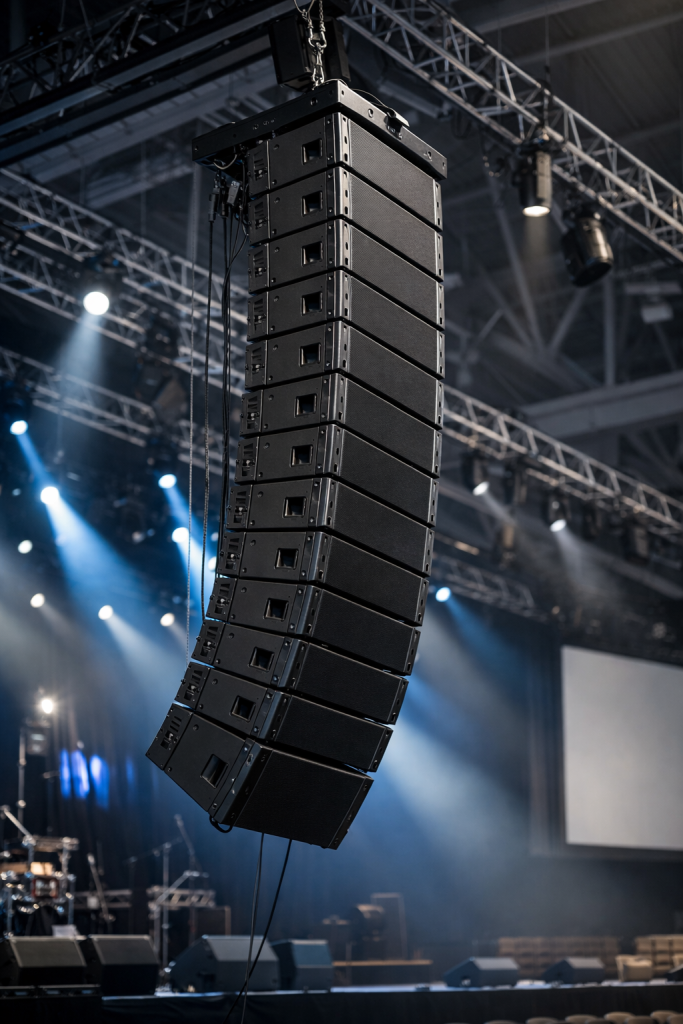
Introduction to Line Array System
A line array system is a professional loudspeaker configuration designed to deliver clear, consistent sound over long distances and large audiences. It is commonly used in concerts, auditoriums, stadiums, conference halls, houses of worship, and outdoor events where traditional speaker systems struggle to provide uniform coverage.
Unlike conventional speaker setups, a line array system focuses on controlled sound dispersion, reduced sound loss, and improved speech intelligibility. When combined with proper acoustic planning, it becomes one of the most effective solutions for large-scale sound reinforcement.
This guide explains how a line array system works, where it is used, its benefits, and why acoustics play a critical role in its performance.
What Is a Line Array System?
A line array system is a vertically arranged series of identical loudspeakers that act together as a single sound source. Instead of spreading sound in all directions, the system projects sound forward in a focused pattern.
Each speaker cabinet is carefully angled to ensure:
- Even sound coverage from front to back
- Minimal volume drop over distance
- Reduced reflections from walls and ceilings
This design makes line array systems ideal for venues where clarity and consistency are essential.
How a Line Array System Works
The working principle of a line array system is based on wave coupling. When multiple speakers are aligned vertically and spaced correctly, their sound waves combine and behave like a single cylindrical wave instead of a spherical one.
Key working characteristics:
- Controlled vertical dispersion limits sound bouncing off ceilings and floors
- Wide horizontal coverage ensures sound reaches all seating areas
- Reduced sound decay allows consistent volume across large distances
This controlled behavior is what separates a line array system from standard PA speakers.
Line Array System vs Traditional PA System
Understanding the difference between a line array system and a traditional PA system helps in choosing the right solution.
Line Array System
- Designed for large venues
- Delivers even sound over long distances
- Minimizes echoes and reflections
- Requires professional design and installation
Traditional PA System
- Suitable for small to medium spaces
- Sound spreads outward and loses energy quickly
- Higher chance of feedback and uneven coverage
- Easier to install but limited in performance
For venues with high ceilings, deep seating areas, or outdoor environments, a line array system is usually the better choice.
Types of Line Array Systems
1. Active Line Array System
An active line array system has built-in amplifiers and signal processing. It offers:
- Faster setup
- Precise tuning
- Reduced external equipment
2. Passive Line Array System
A passive system relies on external amplifiers and processors. It is often preferred for:
- Permanent installations
- Custom acoustic tuning
- Large-scale venues
3. Indoor Line Array System
Designed for controlled environments like auditoriums and conference halls, these systems prioritize clarity and speech intelligibility.
4. Outdoor Line Array System
Built to handle weather conditions and long throw distances, outdoor line arrays focus on power and durability.
Applications of Line Array System
A line array system is widely used across industries:
- Concert venues and music festivals
- Stadiums and sports arenas
- Auditoriums and theaters
- Convention centers
- Houses of worship
- Corporate event spaces
- Outdoor public address systems
In each case, acoustic conditions influence how effective the system will be.
Role of Acoustics in Line Array System Performance
Even the best line array system cannot perform at its full potential without proper acoustic planning. Poor room acoustics can cause:
- Echo
- Sound distortion
- Feedback issues
- Uneven sound distribution
Why acoustics matter:
- Line arrays control sound direction, but reflections still exist
- Hard surfaces amplify noise and reduce clarity
- Untreated spaces waste sound energy
Acoustic treatment helps absorb unwanted reflections and enhances the natural strengths.
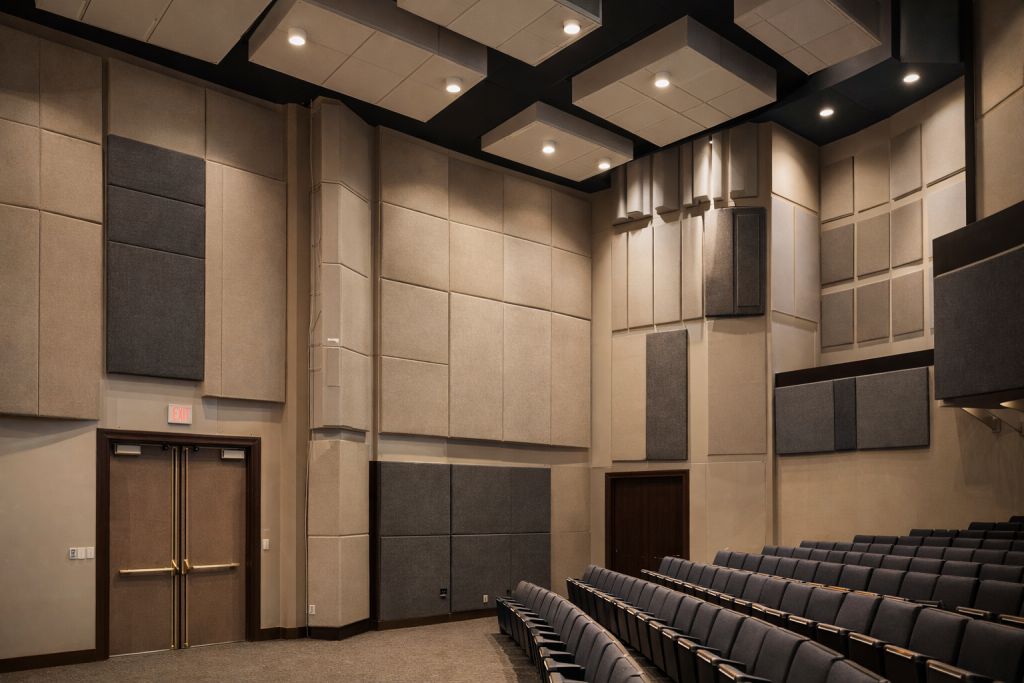
Soundproofing vs Acoustic Treatment in Line Array Installations
These two terms are often confused but serve different purposes.
Soundproofing
- Prevents sound from entering or leaving a space
- Important for venues near residential or commercial areas
- Uses dense materials and structural solutions
Acoustic Treatment
- Improves sound quality within the space
- Reduces echo and reverberation
- Uses absorbers, diffusers, and panels
A line array system benefits most when both are properly addressed.
Key Benefits of a Line Array System
1. Consistent Sound Coverage
Listeners experience similar sound levels regardless of seating position.
2. Improved Speech Intelligibility
Clear vocals make it ideal for conferences, worship spaces, and presentations.
3. Reduced Feedback and Noise
Controlled dispersion minimizes unwanted sound reflections.
4. Scalability
Systems can be expanded or adjusted based on venue size.
5. Professional Audio Experience
When combined with acoustics, it delivers studio-quality sound in live environments.
Common Mistakes When Installing a Line Array System
Many performance issues come from poor planning rather than equipment quality.
Common errors include:
- Ignoring room acoustics
- Incorrect speaker angles
- Overpowering small spaces
- Poor rigging and alignment
- No acoustic measurements before installation
A professionally designed acoustic plan prevents these problems.
Line Array System Design Considerations
Before installing , several factors must be evaluated:
- Venue size and shape
- Ceiling height
- Audience layout
- Wall and surface materials
- Ambient noise levels
Acoustic modeling and sound simulations help predict performance before installation.
Line Array System for Auditoriums and Halls
Auditoriums often face challenges like long reverberation times and reflective surfaces. A line array systems paired with acoustic panels and diffusers ensures:
- Balanced sound distribution
- Reduced echo
- Clear speech and music reproduction
This combination transforms large halls into acoustically efficient spaces.
Maintenance and Optimization of the System
To maintain optimal performance:
- Regularly inspect rigging and alignment
- Recalibrate sound settings
- Monitor acoustic changes after renovations
- Update signal processing when needed
Sound environments change over time, and systems should adapt accordingly.
Choosing the Right System
Selecting the right system depends on:
- Venue purpose
- Audience size
- Acoustic condition
- Budget
- Long-term scalability
Consulting acoustic professionals ensures the system matches both technical and environmental requirements.
Final Thoughts
A line array system is more than a sound system—it is a strategic solution for delivering clear, powerful, and controlled audio in large spaces. When combined with proper acoustic treatment and soundproofing, it provides unmatched performance and listener experience.
Investing in the right design, installation, and acoustic planning ensures that the system performs exactly as intended, delivering clarity, consistency, and impact for years to come.