
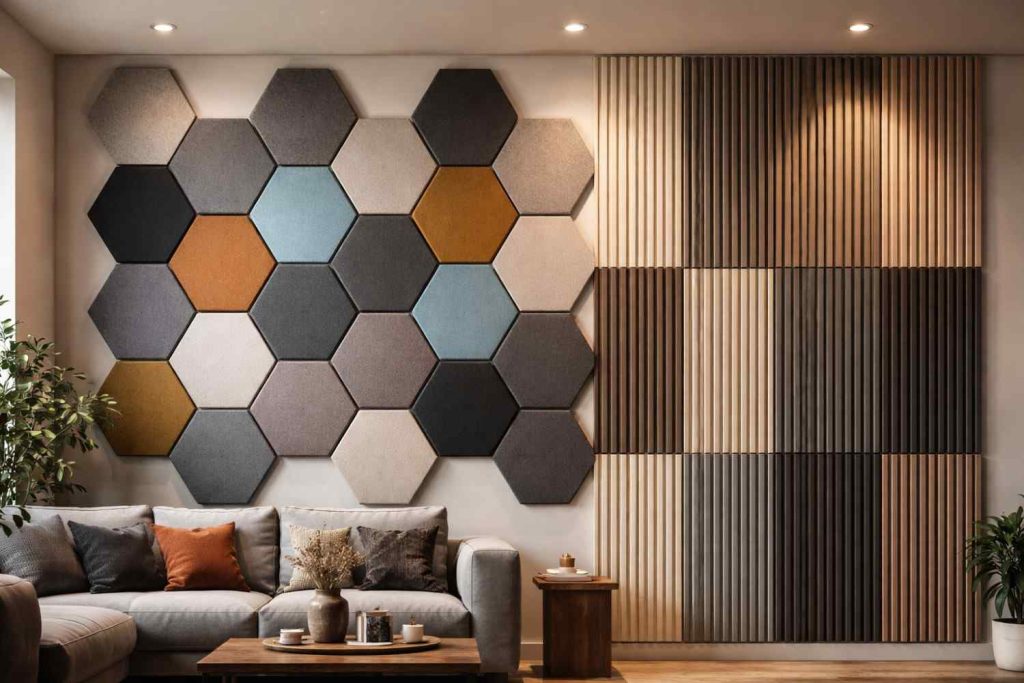
Acoustic wall panels play a vital role in improving sound quality in professional and commercial environments. In offices, studios, auditoriums, and corporate facilities, uncontrolled sound can disrupt communication and reduce efficiency. Therefore, managing sound properly is not a luxury. It is a functional requirement. These panels provide a structured way to reduce echo, control reverberation, and create clear and balanced acoustics.
Moreover, modern workspaces and public venues rely heavily on audio clarity. Meetings, presentations, and performances demand environments where sound travels cleanly and predictably. As a result, acoustic treatment has become a core part of architectural and interior planning.
At first, many people assume these wall panels are only about noise reduction. However, their purpose goes far beyond that. They shape how sound behaves within a space. . And they enhance speech intelligibility. However They improve listening comfort. In addition, they support professional design aesthetics.
Because of this, wall panels are now standard in office complexes, broadcast studios, conference centers, training halls, and performance venues. Their value lies in combining technical performance with visual integration.
What Acoustic Wall Panels Are and Why They Matter
Acoustic wall panels are engineered materials designed to absorb sound energy. Instead of allowing sound waves to reflect freely from walls and ceilings, these panels capture and dissipate that energy. As a result, echo is reduced and clarity is improved.
In untreated environments, sound reflections overlap and build up. This creates noise fatigue and communication difficulties. Consequently, people find it harder to concentrate or understand speech. By installing these panels, the sound field becomes controlled and balanced.
How Acoustic Wall Panels Work
Sound travels in waves. When these waves hit hard surfaces such as concrete, glass, or wood, they bounce back into the environment. Over time, this creates reverberation. Acoustic wall panels counter this effect by absorbing sound waves into their internal structure.
Inside each panel, porous or fibrous materials convert sound energy into low-level heat. Therefore, less sound is reflected back into the room. This results in improved clarity and reduced echo.
In addition, different panel designs target different frequency ranges. Thin panels absorb higher frequencies. Thicker panels manage lower frequencies. As a result, professional installations often combine several types to achieve balanced acoustic control.
Where Acoustic Wall Panels Deliver the Most Impact
Acoustic wall panels are most effective in spaces with hard, reflective surfaces. For example, offices with glass partitions, auditoriums with concrete walls, and studios with smooth ceilings benefit significantly.
In such environments, untreated sound reflection creates distortion. However, with correct placement, panels transform harsh acoustics into controlled sound fields.
They are commonly installed in corporate offices, boardrooms, recording and broadcast studios, educational institutions, conference and training facilities, and performance venues. Each of these spaces requires a specific acoustic strategy. Therefore, panel selection and layout should always be based on function.
Acoustic Wall Panels in Office Environments
In offices, sound clarity directly affects productivity. Background noise reduces focus and increases mental fatigue. Therefore, these wall panels office solutions are now part of modern workplace design.
By absorbing excessive sound reflections, panels create calmer working conditions. Meetings become easier to conduct. Conversations stay more contained. Employees experience less distraction.
Moreover, acoustic treatment supports professional communication. Clear sound allows ideas to be exchanged without repetition or misunderstanding. As a result, collaboration improves and stress levels decrease.
Acoustic Fabric Wall Panels for Flexible Design
Acoustic fabric wall panels are widely used because of their adaptability. They combine a sound-absorbing core with an acoustically transparent fabric surface. This allows sound to pass through while maintaining visual consistency.
In addition, fabric panels offer design flexibility. They come in various colors and textures, making them suitable for corporate branding and interior themes.
Furthermore, they are lightweight and easy to install. This makes them a practical choice for offices, studios, and training rooms where sound control and visual consistency need to work together.
Acoustic Wall Panel Design as an Architectural Element
Acoustic wall panel design has evolved from hidden functionality to visible artistry. Today, panels are intentionally displayed as part of interior architecture.
For instance, panels can be arranged in geometric patterns or feature-wall layouts. This allows sound control systems to enhance visual identity instead of disrupting it.
Therefore, decorative acoustic wall panels combine engineering precision with creative expression. They transform plain walls into functional design assets.
3D Acoustic Wall Panels for Advanced Sound Control
3D acoustic wall panels provide both absorption and diffusion. Their sculpted shapes break up sound reflections more effectively than flat surfaces.
Consequently, sound becomes evenly distributed throughout the space. This prevents harsh sound hotspots and improves acoustic balance.
These panels are especially valuable in creative studios, presentation halls, and corporate innovation spaces where both sound and visual impact matter.
Acoustic Wood Wall Panels for Natural Elegance
Acoustic wood wall panels integrate warmth with performance. Their perforated or slotted surfaces allow sound to enter the panel structure while preserving a natural appearance.
They are commonly used in auditoriums, executive boardrooms, and public venues where design prestige is essential.
Moreover, wood panels offer durability and long-term performance. Therefore, they serve both technical and architectural purposes.
Auditorium Acoustic Wall Panels for Large-Scale Sound Control
Auditoriums require precise acoustic planning. Without proper treatment, sound becomes distorted and unclear. That is why auditorium acoustic wall panels are fundamental in such environments.
They control reverberation time and ensure uniform sound distribution. Consequently, speech remains intelligible and performances maintain clarity.
In these spaces, acoustic design is part of structural engineering rather than an optional addition.
Professional Screening and Production Spaces
In professional screening rooms and media production environments, acoustic wall panels are used to simulate cinema-level sound quality.
These spaces demand controlled acoustics for accurate monitoring and playback. Panels remove unwanted reflections and improve sound precision.
Although originally associated with entertainment, these systems are now widely applied in broadcast facilities and post-production studios.
Installation Strategy and Placement Planning
Correct installation determines effectiveness. Even the best panels fail if placed incorrectly.
Panels should be installed at primary reflection points. These are the areas where sound first hits the walls after leaving the source.
In office spaces, panels are typically installed around the level where people speak for better voice clarity.
Auditoriums use a wider layout, spreading panels over large wall and ceiling areas to manage echo.
For studios, positioning is carefully planned based on the direction and behavior of sound sources.
Therefore, acoustic planning must precede installation. Balanced coverage ensures natural sound control without making the space feel acoustically flat.
Choosing the Right Materials
Material choice affects performance and durability.
Acoustic fabric wall panels are ideal for speech clarity and general absorption.
Acoustic wood wall panels provide architectural sophistication and durability.
3D acoustic wall panels deliver both absorption and diffusion.
Each option serves different acoustic goals. As a result, combining materials often yields the best outcome.
Maintenance and Durability
Modern panels require minimal maintenance. Regular dust removal and periodic inspection preserve performance.
When properly installed, acoustic wall panels remain effective for many years. They resist structural deformation and maintain sound absorption characteristics.
This durability makes them a long-term acoustic investment.
Sustainability and Environmental Responsibility
Many manufacturers now use recycled materials and low-emission components.
These eco-friendly solutions maintain high performance while supporting sustainability objectives.
Thus, acoustic design and environmental responsibility can coexist in professional construction projects.
Measuring Acoustic Performance and Results
In professional environments, results must be measurable. Acoustic treatment is evaluated through reverberation time, speech intelligibility, and sound clarity.
When acoustic wall panels are installed correctly, reverberation time decreases significantly. As a result, speech becomes sharper and less tiring to understand.
Moreover, sound balance improves across the space. This consistency is essential in commercial facilities where audio quality must remain stable.
Common Mistakes That Reduce Effectiveness
One frequent mistake is under-installation. Adding only a small number of panels rarely solves sound issues. Sound treatment must be evenly distributed to manage reflections effectively.
Another error is selecting panels based only on appearance. While design matters, performance ratings must guide decisions. Decorative acoustic wall panels should still meet technical absorption standards.
Confusing sound control with soundproofing is also common. Panels regulate sound within a space. They do not stop sound from passing through walls.
Why Acoustic Wall Panels Are a Long-Term Asset
In commercial facilities, investment decisions focus on long-term value. Acoustic wall panels provide consistent performance over many years.
They help create better communication in offices, bring sharper clarity to studio environments, and significantly elevate the overall experience in auditoriums and educational institutions.
Because of this, sound treatment is now viewed as infrastructure rather than decoration.
How Acoustic Planning Improves Professional Environments
Acoustic design supports productivity and professionalism. When sound is controlled, meetings become more efficient. Training sessions become easier to follow. Performances maintain clarity and impact.
Moreover, sound comfort reduces stress. People work better in spaces where they do not struggle to hear or be heard.
This practical value is why acoustic wall panels are standard in high-performance architectural projects.
Conclusion
Sound quality defines how a space performs. When sound is uncontrolled, even the most visually impressive environment becomes uncomfortable. Acoustic wall panels provide a reliable way to shape sound behavior and improve communication.
They enhance clarity, reduce reverberation, and support professional standards across offices, studios, auditoriums, and commercial facilities. When chosen correctly and installed strategically, they become a permanent improvement to operational quality.
By combining performance engineering with modern design, these wall panels deliver measurable results that support both function and form.
FAQs
1. How many panels are needed in a commercial space?
The number depends on room size, surface materials, and sound usage. Balanced placement across reflective areas provides the best performance.
2. Can panels be installed on ceilings in large facilities?
Yes. Ceiling installation is highly effective in spaces with high ceilings or strong vertical sound reflections.
3. Do these wall panels require professional installation?
For large or complex spaces, professional installation ensures correct placement and maximum effectiveness.
4. How long do these panels maintain performance?
High-quality panels maintain acoustic efficiency for many years when properly maintained.
5. Can panels support corporate branding and design?
Yes. Acoustic fabric wall panels and decorative acoustic wall panels can be customized to match corporate identity and architectural themes.