
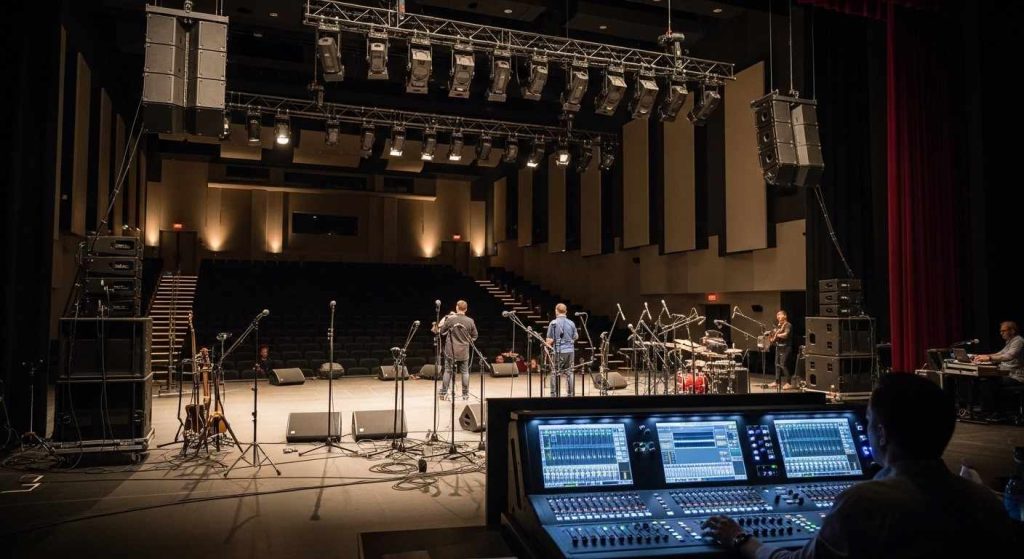
Delivering crystal-clear audio in large venues demands more than expensive equipment it requires understanding how professional auditorium sound system design truly works. Whether you’re managing a performing arts center, conference hall, worship space, or educational facility, audio quality directly impacts audience experience and venue reputation.
After designing and installing sound systems in more than 100 auditoriums, from 200-seat theaters to 2,000-seat concert halls, I have found the essential elements that distinguish great sound from poor sound. This comprehensive guide reveals everything you need to know about auditorium sound systems, from component selection to acoustic optimization.
Understanding Auditorium Sound System Fundamentals
What Makes Auditorium Audio Different?
Auditorium sound system requirements differ dramatically from smaller venue installations due to several unique challenges:
Coverage Complexity: Large spaces require sound reaching every seat with consistent volume and clarity. The person in row 1 and row 50 should experience nearly identical audio quality an engineering challenge requiring sophisticated solutions.
Acoustic Variables: Room shape, ceiling height, wall materials, seating configuration, and architectural features create complex acoustic environments affecting sound behavior. Hard surfaces cause reflections and echoes while soft materials absorb sound energy.
Distance Management: Sound naturally loses energy over distance. In auditoriums spanning 50-100+ feet from stage to back row, maintaining consistent volume and frequency response requires strategic speaker placement and specialized equipment.
Multiple Use Cases: Modern auditoriums host diverse events theatrical performances, musical concerts, corporate presentations, film screenings. Each application demands different audio characteristics from the same system.
Audience Size Fluctuations: Systems must perform equally well for 50 people or 500 people, despite how audience presence dramatically alters room acoustics through sound absorption.
Core Components of Professional Auditorium Sound Systems
Main Speaker Arrays
The primary auditorium sound system speakers carry the majority of program material:
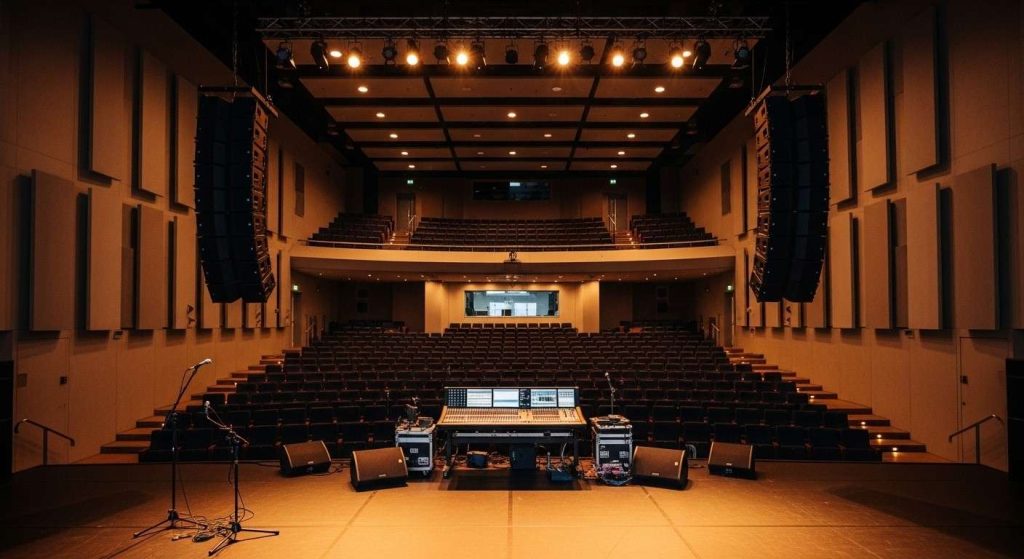
Line Array Systems: Multiple speakers arranged vertically create controlled vertical coverage patterns ideal for long, narrow spaces. Line arrays direct sound precisely where needed, minimizing wall reflections that muddy clarity. Best for venues 300+ seats requiring exceptional speech intelligibility and musical fidelity.
Point Source Systems: Traditional approach using fewer, more powerful speakers positioned strategically. More cost-effective for smaller auditoriums (under 300 seats) but requiring careful placement preventing dead zones or hot spots.
Distributed Systems: Multiple smaller speakers throughout the ceiling provide even coverage for spaces with challenging layouts or low ceilings. Excellent for lecture halls prioritizing speech clarity over musical performance.
Subwoofers and Low Frequency Management
Bass frequencies behave differently than mid and high frequencies, requiring dedicated management:
Subwoofer Placement: Strategic positioning of low frequency speakers prevents uneven bass distribution creating “boomy” or “thin” spots throughout the venue. Professional installations often use multiple subwoofers positioned asymmetrically optimizing coverage.
Integration Challenges: Properly blending subwoofers with main speakers ensures seamless frequency response without gaps or overlaps. Poor integration causes muddy low-mids or disconnected bass lacking musical cohesion.
Amplification and Processing
Power Amplifiers: Provide electrical power driving speakers. Modern installations use efficient Class-D amplifiers reducing heat, weight, and power consumption while delivering clean, powerful audio. Proper amplifier sizing ensures adequate headroom preventing distortion during dynamic peaks.
Digital Signal Processors (DSP): The brain of professional auditorium sound system installations. DSPs handle equalization, crossover filtering, delay alignment, limiting, and routing. Quality DSPs with properly programmed settings transform mediocre systems into exceptional ones.
System Controllers: Provide user-friendly interfaces for operators adjusting volume, routing, and presets without accessing complex DSP parameters. Essential for venues employing multiple operators with varying technical expertise.
Microphones and Input Systems
Wireless Microphone Systems: Professional-grade wireless systems prevent interference, dropouts, and audio degradation. Critical for theatrical performances, conferences, and worship services requiring freedom of movement.
Boundary Microphones: Installed on stages or podiums for capturing speech without handheld or lavalier microphones. Excellent for panel discussions and formal presentations.
Hanging Choir Microphones: Positioned above choirs, orchestras, or instrumental ensembles capturing natural sound without visible microphones disrupting aesthetics.
Acoustic Treatment: The Often-Overlooked Critical Factor
Why Acoustics Matter More Than Equipment
Even the finest auditorium sound system performs poorly in acoustically problematic spaces. Room acoustics determine whether sound reinforcement enhances or fights natural sound behavior.
Reverberation Time: The duration sound persists after the source stops. Excessive reverberation muddles speech intelligibility and musical clarity. Insufficient reverberation makes spaces sound “dead” and unpleasant. Optimal reverberation varies by venue purpose speech-focused venues need shorter times (1.0-1.5 seconds) while concert halls benefit from longer reverberation (1.8-2.2 seconds).
Echo Control: Distinct echoes occur when reflections return noticeably delayed from the original sound. Particularly problematic in venues with parallel walls, domed ceilings, or rear balconies facing hard stage walls.
Flutter Echo: Rapid repetitive echoes between parallel reflective surfaces create metallic or ringing qualities degrading audio quality significantly.
Acoustic Treatment Solutions
Absorption Panels: Reduce overall reverberation and control specific reflections. Strategic placement on side walls, rear walls, and ceiling addresses primary acoustic issues. Modern acoustic panels integrate architecturally maintaining aesthetic appeal while improving audio performance.
Diffusion Panels: Scatter sound reflections reducing echo problems without over-deadening spaces. Particularly effective on rear walls and balcony fronts where absorption alone creates unnatural acoustics.
Bass Traps: Control low-frequency buildup in corners and boundaries where bass naturally accumulates. Essential for achieving even bass response throughout the venue.
Ceiling Clouds: Suspended acoustic panels controlling ceiling reflections that compromise speech intelligibility. Common in lecture halls and conference centers prioritizing spoken word clarity.
Design Considerations for Optimal Performance
Coverage Pattern Planning
Professional auditorium sound system design begins with detailed coverage analysis:
Horizontal Coverage: Speakers must provide consistent sound across the width of the seating area. Insufficient horizontal coverage creates dead zones at extreme sides. Excessive overlap causes comb filtering degrading frequency response.
Vertical Coverage: Proper vertical aiming ensures front rows receive appropriate levels without excessive volume while reaching distant seats with adequate energy. Incorrect vertical aiming wastes acoustic energy hitting ceilings, walls, or empty floor space.
Speaker Splay Angles: In line array installations, individual elements angle relative to each other creating controlled coverage patterns. Professional design software calculates optimal splay angles based on venue geometry and seating layout.
Integration with Architecture
Successful installations balance acoustic performance with architectural aesthetics:
Visual Integration: Modern speaker systems integrate architecturally through custom colors, discreet mounting, or decorative grilles matching venue aesthetics. Visible speakers need not compromise design vision with proper planning and coordination.
Structural Considerations: Speaker arrays, particularly line arrays, impose significant structural loads. Proper mounting requires structural engineering ensuring adequate support preventing catastrophic failures.
Sightline Preservation: Speaker placement must avoid blocking audience sightlines to stage action. Careful coordination between audio designers, architects, and theater consultants prevents conflicts.
Selecting the Right Auditorium Sound System
Matching System to Venue Requirements
Venue Size and Seating Capacity: Determines required speaker quantity, power handling, and system architecture. Small venues (under 200 seats) need simpler systems than large halls (1,000+ seats) requiring sophisticated solutions.
Primary Use Cases: Speech-focused venues prioritize intelligibility metrics like Speech Transmission Index (STI). Musical performance venues emphasize frequency response, dynamic range, and sonic character. Multi-purpose spaces require flexibility accommodating diverse requirements.
Budget Realities: Professional installations range from $50,000 for basic systems in 200-seat venues to $500,000+ for sophisticated concert hall installations. Balancing performance requirements with budget constraints requires expertise identifying essential components versus nice-to-have features.
Future Expansion: Quality installations include infrastructure supporting future upgrades adequate power capacity, signal routing flexibility, processing headroom. Planning expansion paths prevents costly retrofits when requirements change.
Professional vs. Consumer Equipment
Auditorium sound system installations demand professional-grade equipment offering:
Reliability: Commercial speakers and electronics withstand constant use without degradation. Consumer equipment lacks robustness for commercial applications.
Serviceability: Professional equipment provides replaceable components, available spare parts, and manufacturer support ensuring long-term operation.
Performance Specifications: Professional systems meet rigorous performance standards for frequency response, distortion, coverage patterns, and power handling that consumer equipment cannot achieve.
Warranty and Support: Commercial equipment includes multi-year warranties and technical support critical for mission-critical applications.
Installation and Commissioning Process
Professional Installation Requirements
Structural Assessment: Engineers evaluate structural capacity supporting speaker loads, particularly for rigging line arrays or large format speakers.
Cable Infrastructure: Permanent installations require concealed cable routing meeting electrical codes and aesthetic requirements. Proper cable management prevents failures and facilitates future maintenance.
System Commissioning: Professional calibration using measurement microphones and analysis software optimizes frequency response, coverage patterns, and system integration. Proper commissioning dramatically improves performance beyond equipment specifications alone.
Operator Training: Comprehensive training ensures staff operate systems effectively, troubleshoot basic issues, and understand proper maintenance procedures.
Maintenance and Long-Term Performance
Preventive Maintenance Essentials
Regular Inspections: Annual professional inspections identify developing issues before they cause failures—loose connections, degrading cables, failing amplifiers.
Firmware Updates: Modern digital systems receive periodic firmware updates improving performance, adding features, or addressing discovered issues.
Recalibration: Acoustic properties change over time as furnishings change, speakers age, or room treatments degrade. Periodic recalibration maintains optimal performance.
Spare Parts Inventory: Critical components microphones, cables, amplifier modules should be stocked preventing extended downtime during failures.
Conclusion: Invest Wisely in Your Auditorium Sound System
Exceptional auditorium sound system performance results from understanding that audio quality depends equally on equipment selection, acoustic environment, system design, professional installation, and ongoing maintenance. Cutting corners in any area compromises overall results regardless of investment in other areas.
Engage experienced acoustical consultants and audio system integrators who are knowledgeable about the challenges of large venue sound. Their expertise prevents costly mistakes, ensures optimal performance, and creates systems serving your venue excellently for decades.
Remember that your sound system directly impacts every event hosted in your venue. Poor audio frustrates audiences, limits event types you can host, and damages venue reputation. Quality systems enhance every performance, expand programming possibilities, and become valued assets supporting your mission for years to come.
Frequently Asked Questions
Q1: What’s the average cost for a professional auditorium sound system?
Costs vary dramatically by venue size and requirements. Small auditoriums (200 seats) typically require $50,000-$100,000 for quality systems. Mid-size venues (500 seats) range $150,000-$300,000. Large concert halls (1,000+ seats) often exceed $500,000. These figures include equipment, installation, acoustic treatment, and commissioning. Budget systems exist but typically compromise performance and longevity.
Q2: How long do auditorium sound systems typically last?
Professional systems last 15-25 years with proper maintenance. Speakers typically outlast electronics amplifiers and processors often need replacement after 10-15 years as technology evolves. Regular maintenance and periodic upgrades extend system lifespan significantly. Many venues replace systems driven by obsolescence rather than failure as newer technology offers superior performance.
Q3: Can we install an auditorium sound system ourselves to save money?
Professional installation is strongly recommended for venues over 200 seats. Proper design requires specialized software, acoustic measurement equipment, and extensive experience. Installation involves structural engineering, electrical code compliance, and sophisticated calibration. DIY installations typically underperform dramatically and may create safety hazards. Savings from avoiding professional installation often become expenses correcting problems or eventually replacing failed systems.
Q4: What’s the difference between line array and point source speakers for auditoriums?
Line arrays use multiple smaller speakers vertically arranged creating controlled vertical coverage ideal for large, deep venues. They provide exceptional speech intelligibility and even coverage but cost more. Point source systems use fewer, larger speakers suitable for smaller venues or stages requiring wide horizontal coverage. Choice depends on venue geometry, seating configuration, budget, and performance requirements. Professional analysis determines optimal approach.
Q5: How important is acoustic treatment compared to equipment quality?
Equally critical. The finest sound system cannot overcome poor acoustics excessive reverberation, echo problems, or uneven frequency response caused by room characteristics. Conversely, excellent acoustics allow modest systems performing admirably. Successful installations address both simultaneously. Budget allocations should include acoustic treatment, not just equipment. Many venues achieve better results spending 70% on moderate equipment plus acoustics versus 100% on premium equipment alone.