
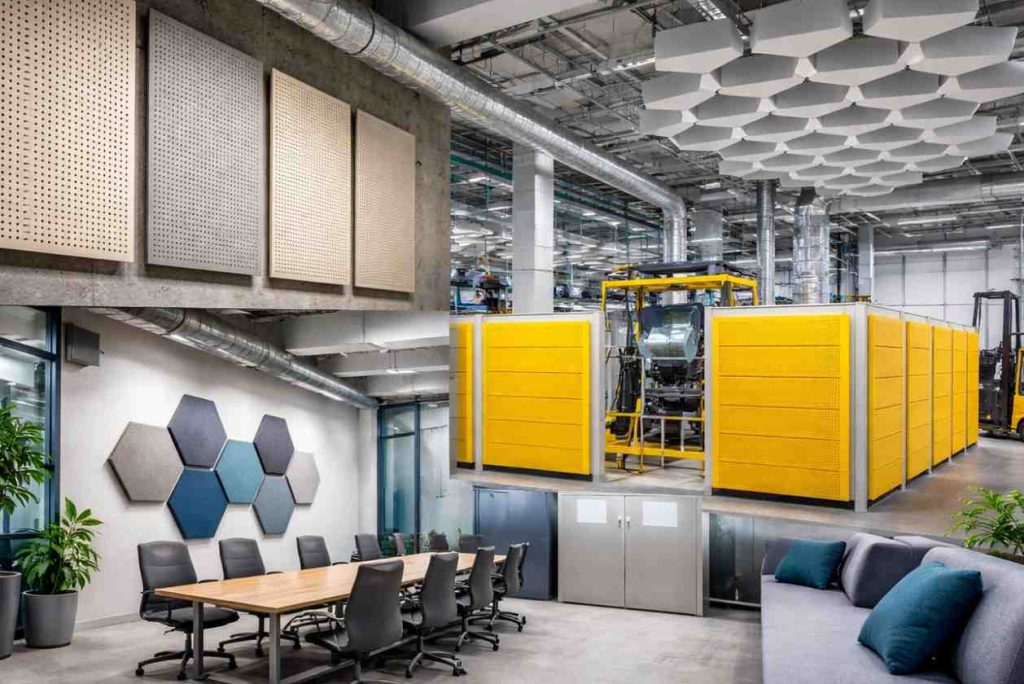
Acoustic protection is no longer a luxury in modern construction. It is a necessity for any space where performance, safety, and communication matter. From factories and warehouses to offices, studios, and commercial buildings, sound has a direct impact on how people work, interact, and stay productive. Poor acoustic conditions increase stress, reduce concentration, and create long-term operational problems.
True acoustic treatment is not about making a space silent. It is about creating balance. It controls unwanted noise, improves sound clarity, and manages how sound energy behaves inside a structure. When done properly, it transforms noisy environments into controlled, efficient, and comfortable spaces.
In professional environments, sound becomes a design parameter just like lighting, ventilation, or safety. That is why acoustic protection is now part of strategic planning, not just technical correction.
Understanding Acoustic Protection Beyond Basic Soundproofing
Many people confuse acoustic protection with simple soundproofing. Soundproofing focuses mainly on stopping sound from traveling between spaces. Acoustic protection goes deeper. It manages the behavior of sound inside a space while also controlling vibration and structural transmission.
It addresses three critical areas:
- How sound is generated
- How sound travels
- How sound is perceived
This broader approach allows acoustic protection to work effectively in complex environments such as industrial zones, corporate offices, and technical facilities.
Why Noise Control Is a Business and Safety Issue
Noise is not just uncomfortable. It directly affects accuracy, productivity, and long-term health. “In industrial environments, excessive noise reduces worker alertness and increases safety risks, while in offices it lowers focus and communication quality. Commercial spaces face different challenges as noise weakens customer experience and brand perception.
This is where industrial noise control becomes essential. It protects people, supports operational efficiency, and ensures regulatory compliance. Acoustic protection is the foundation that allows noise control strategies to perform reliably over time.
How Acoustic Protection Works at a Technical Level
Sound is energy. It travels through air and through solid structures. When it meets hard surfaces, it reflects. When it enters structures, it vibrates. Acoustic protection works by controlling both behaviors.
It uses three physical principles:
- Absorption – reducing reflections and echo
- Isolation – limiting sound transfer between areas
- Damping – controlling vibration inside materials
These principles are combined into professional noise control systems that stabilize sound behavior in complex spaces.
Acoustic Barriers and Their Role in Sound Control
Acoustic barriers are one of the most visible components of acoustic protection. They block or redirect sound energy at its source. In factories and industrial facilities, they are used to isolate noisy machinery from occupied areas.
Unlike simple partitions, acoustic barriers are engineered to absorb part of the sound while reflecting and blocking the rest. This reduces both direct noise and secondary reflections.
When combined with vibration control and absorption materials, barriers become highly effective in demanding environments.
Industrial Noise Control in High-Intensity Environments
Industrial facilities face continuous noise exposure from machines, compressors, ventilation systems, and production lines. Without structured control, sound accumulates and spreads through structures.
Acoustic protection supports industrial noise control by:
- Reducing sound reflection
- Limiting vibration transmission
- Improving working conditions
- Supporting equipment performance
This is where industrial acoustic panels play a vital role. They are designed for durability and high absorption while surviving harsh operating conditions.
Factory Soundproofing as a Complete Acoustic Strategy
Factory soundproofing is often misunderstood as enclosing machines only. In reality, it requires a full acoustic protection strategy. Machines generate both airborne noise and structural vibration. If only one is treated, results remain limited.
Proper factory soundproofing includes:
- Vibration isolation
- Sound absorption on reflective surfaces
- Structural sealing
- Controlled airflow paths
This layered approach allows factories to reduce noise while maintaining productivity and safety.
The Role of Sound Absorption Panels in Acoustic Protection
Sound absorption panels are essential for managing reflections. They improve clarity and reduce echo. However, they do not block sound. Their strength lies in improving sound quality within a space.
- Stabilize sound behavior
- Improve speech intelligibility
- Reduce listening fatigue
- Support professional communication
They are widely used in offices, studios, conference rooms, and control centers.
Commercial Soundproofing and Acoustic Performance
Commercial soundproofing focuses on preventing noise leakage between spaces. Acoustic protection strengthens this by improving internal sound behavior. Together, they create privacy and clarity.
In commercial buildings, this combination is essential for:
- Meeting rooms
- Training facilities
- Corporate offices
- Technical environments
Without acoustic protection, soundproofing alone cannot deliver consistent acoustic performance.
Office Acoustic Treatment as a Productivity Tool
Modern offices use open designs, glass partitions, and shared spaces. These features increase sound reflection. Office acoustic treatment becomes a necessity, not a design preference.
Acoustic protection improves office environments by:
- Reducing background noise
- Improving conversation clarity
- Supporting focused work
- Enhancing employee comfort
This directly increases efficiency and professional standards.
Noise Control Systems as Integrated Solutions
Professional noise control systems combine materials, design, and installation into one cohesive solution. They are not product-based; they are system-based.
These systems analyze:
- Noise sources
- Structural behavior
- Room geometry
- Operational requirements
Then they apply targeted acoustic protection solutions that work together instead of independently.
Warehouse Noise Reduction Through Acoustic Planning
Warehouses present a special challenge. Their size and surface hardness amplify sound. Machinery, material handling, and vehicle movement create constant noise.
Warehouse noise reduction becomes effective when acoustic protection is applied through:
- Ceiling absorption
- Wall-mounted acoustic materials
- Structural vibration control
This improves safety communication and reduces long-term stress.
Commercial Acoustic Treatment as a Long-Term Investment
Commercial acoustic treatment is where acoustic protection becomes truly strategic. It is not applied only to solve an immediate noise problem. It is implemented to improve how a space performs every day. In offices, conference rooms, training centers, and corporate buildings, sound quality directly affects communication, concentration, and professionalism.
When acoustic protection is paired with commercial acoustic treatment, the environment becomes predictable. Conversations remain clear. Background noise stays controlled. Meetings feel more focused. Over time, this improves productivity and reduces fatigue.
Rather than reacting to noise complaints, businesses that invest in acoustic protection design spaces that naturally support calm and clarity.
How Acoustic Protection Strengthens Warehouse Noise Reduction
Warehouses are acoustically challenging because of their scale. High ceilings, hard walls, and open layouts cause sound to travel far and reflect endlessly. Forklifts, conveyor belts, and handling systems add continuous noise.
Acoustic protection improves warehouse noise reduction by changing how sound behaves in the space. Instead of allowing sound to bounce and build up, absorption materials stabilize the environment. Vibration control prevents machinery noise from spreading through steel structures and floors.
The result is not silence, but control. Workers communicate more easily. Safety signals are heard clearly. Stress caused by constant background noise is reduced. Over time, this leads to safer and more efficient operations.
Factory Soundproofing as a System, Not a Product
Factory soundproofing fails when it is treated as a single solution. Enclosing a machine without controlling vibration or reflections often leads to limited improvement. Real acoustic protection treats factory soundproofing as a complete system.
Sound in factories exists in two forms: airborne noise and structural vibration. If vibration is ignored, noise will still spread through walls and floors. If reflections are ignored, sound will continue to build inside the space.
Acoustic protection strengthens factory soundproofing by:
- Managing vibration at the source
- Absorbing reflected sound
- Stabilizing noise behavior
- Protecting worker safety
This layered approach ensures consistent and measurable noise reduction.
Industrial Acoustic Panels and Their Performance Role
Industrial acoustic panels are not decorative. They are engineered for heavy environments where noise levels are high and durability is critical. They maintain their performance under heat, dust, and continuous operation.
In acoustic protection, industrial acoustic panels serve three purposes:
- They reduce sound reflections
- They stabilize noise energy
- They support long-term performance
Without these panels, sound becomes uncontrolled, especially in large production areas. With them, noise remains manageable and predictable.
Acoustic Protection in Office and Corporate Environments
Noise problems in offices are usually subtle but damaging. Phone calls overlap. Meetings echo. Concentration breaks easily.
Acoustic protection improves office acoustic treatment by managing sound at its behavioral level. Instead of simply blocking noise, it reshapes how sound travels and fades. This creates environments where conversations feel natural and focus becomes easier.
It also enhances:
- Privacy
- Professional presentation
- Employee comfort
- Mental clarity
Sound becomes supportive rather than disruptive.
How Noise Control Systems Bring Everything Together
Noise control systems represent the structured application of acoustic protection. They are built through analysis, not guesswork. Professionals measure sound sources, identify reflection paths, and evaluate vibration patterns before selecting materials.
A proper system combines:
- Absorption to control reflections
- Isolation to block sound movement
- Damping to stop vibration
- Sealing to prevent leakage
This integrated design makes noise control reliable instead of experimental.
Choosing the Right Materials for Acoustic Protection
Material selection defines long-term performance. Poor materials degrade quickly and lose effectiveness. High quality materials maintain stability and acoustic integrity for years.
When selecting materials, professionals consider:
- Noise frequency range
- Environmental conditions
- Structural behavior
- Installation compatibility
This is why acoustic or sound protection is never product driven. It is system driven.
Common Failures That Reduce Acoustic Performance
Many projects underperform because of avoidable mistakes. The most common issue is treating soundproofing and acoustic protection as the same thing. Soundproofing alone cannot stabilize sound behavior.
Other failures include:
- Ignoring vibration control
- Overusing absorption without balance
- Choosing materials without testing
- Poor installation accuracy
- Skipping professional acoustic assessment
True acoustic protection requires design discipline, not shortcuts.
Cost vs. Value in Acoustic Protection
Acoustic protection should be measured by value, not just cost. The immediate expense often feels high, but the long-term benefits are far greater.
These include:
- Increased productivity
- Reduced stress and fatigue
- Improved safety
- Better communication
- Professional credibility
Over time, these benefits outweigh installation costs and create strong operational returns.
Maintenance and Longevity
One of the strengths of acoustic protection is its durability. Once installed properly, it requires minimal maintenance. Periodic inspection ensures materials remain stable and effective.
This makes acoustic protection one of the most cost-efficient improvements in professional buildings.
The Future of Acoustic Protection
Modern design is moving toward integrated acoustic planning. Sound protection is becoming part of architectural design, not an afterthought.
Future developments include:
- Smarter material technology
- Sustainable acoustic systems
- Advanced noise modeling
- Thinner, higher-performance materials
As buildings become more complex, sound protection will define professional design quality.
Conclusion
Acoustic protection is the foundation of professional noise control. It shapes how sound behaves, how spaces perform, and how people experience their environment. From industrial noise control and factory soundproofing to office acoustic treatment and warehouse noise reduction, it ensures balance, clarity, and safety.
By combining acoustic barriers, sound absorption panels, industrial these panels, and intelligent noise control systems, acoustic protection transforms chaotic sound environments into structured and productive spaces.
It is not just about reducing noise. It is about building environments that work better, feel better, and perform better.
FAQs
1. What makes acoustic protection different from basic soundproofing?
Soundproofing blocks sound movement between spaces, while acoustic protection manages sound behavior, controls reverberation, and reduces vibration within a room for better sound quality.
2. Is this solution suitable only for industrial environments?
No, these systems are equally important in offices, warehouses, commercial buildings, restaurants, hospitals, and educational facilities where sound quality matters.
3. Can proper acoustic treatment improve communication quality?
Yes, it significantly enhances speech clarity, reduces echo and sound distortion, and creates better environments for meetings, calls, and presentations.
4. Does noise control infrastructure require frequent maintenance?
No, high-quality acoustic systems remain stable and effective with minimal maintenance once properly installed by professionals.
5. Is investing in sound management a long-term solution?
Yes, professional acoustic solutions deliver consistent performance, reduce operational disruptions, and provide lasting value for decades with proper installation.